
Scroll Facebook or TikTok in the Philippines and it won't take long to find one. An influencer streaming a slot game as bonus rounds cascade towards a “Php 100,000 big win”, worth about US$1,600. The script rarely changes. The win is real, they say, and it could happen to anyone, just click the link in the bio.
The comments tell a different story. Some viewers ask whether the link is legitimate. Others share their own "paldo" moments, a Filipino slang term for hitting it big or suddenly having plenty of money. And a few quietly admit they lost money chasing their losses.
It's a pattern repeated across platforms, influencers, and celebrities. Behind it sits a market that moves fast. In September 2025, the Philippine Amusement and Gaming Corporation (PAGCOR), the country's gaming regulator, told the Senate that 11,985 illegal gambling sites were operating in the country, including 6,363 offering online casino games.
Many of these sites look the part, with polished designs, generous bonus headlines, and badges that appear official. Some go further still, offering fake copies of popular games. For players, telling the difference is far harder than it should be.
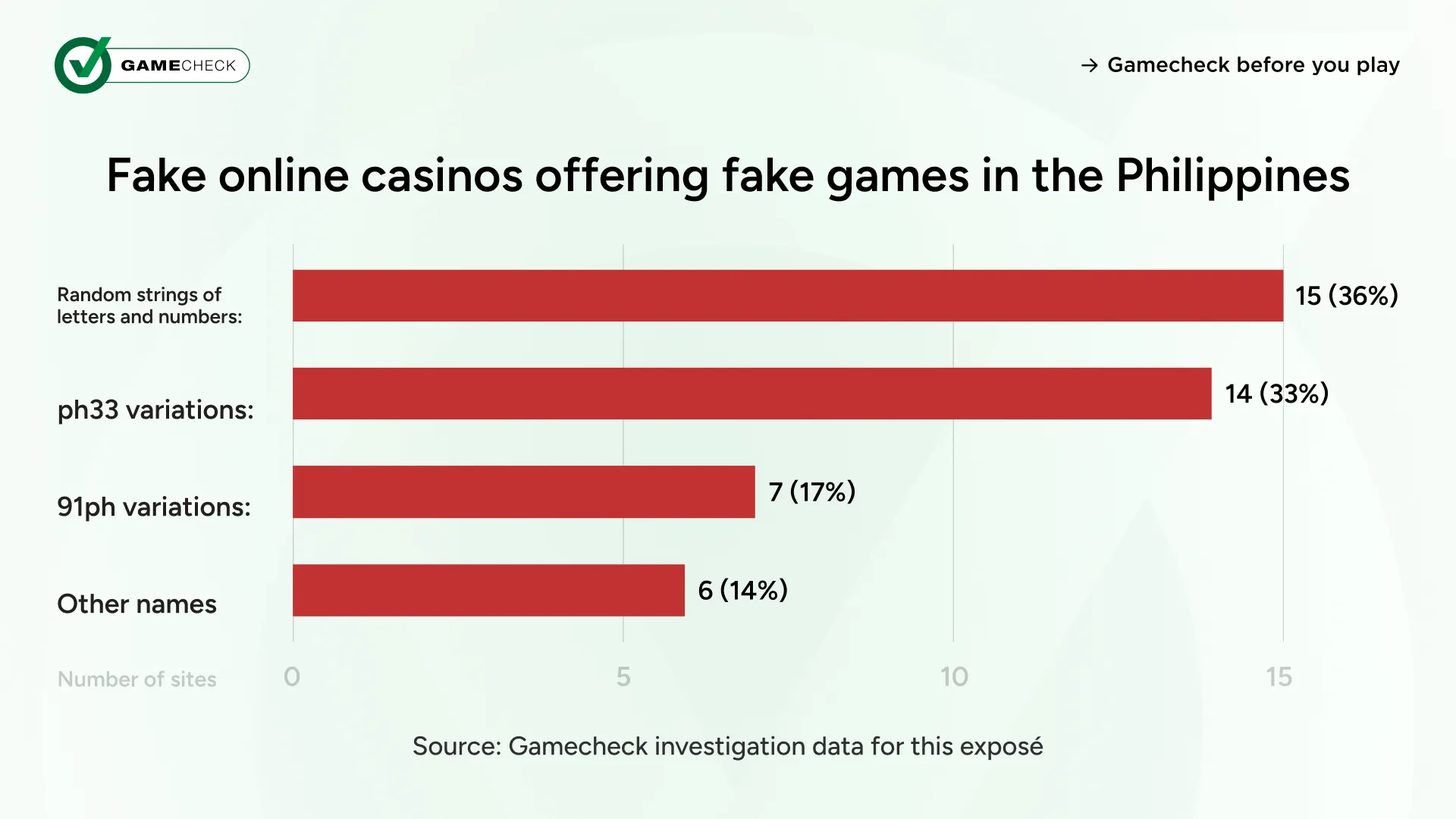
Gamecheck's latest checks found 42 sites offering fake games to players in the Philippines. Look closely at the names and a pattern appears. Fifteen are random strings of letters and numbers, fourteen are variations of "ph33", seven are variations of "91ph". This is domain recycling in practice: change a character, add a number, and relaunch. When one address disappears, a near-identical one is ready to take its place.
Each name below links to its Gamecheck profile, where you can see the result for that site.
Recognise one of these names, or one that looks the same? Search the web address on Gamecheck before you deposit and see the result for yourself using our free tools.
Industry reports, player accounts, and Gamecheck's own checks point to a consistent playbook.
The official figures show the scale.
Between September 2022 and October 2025, PAGCOR reported 13,399 sites it classes as illegal to its partner agencies. Of these, the National Telecommunications Commission (NTC) blocked 12,562, or 93.8%. PAGCOR credits a new AI detection tool for much of that progress. Only two months earlier, the block rate stood at around 74%.
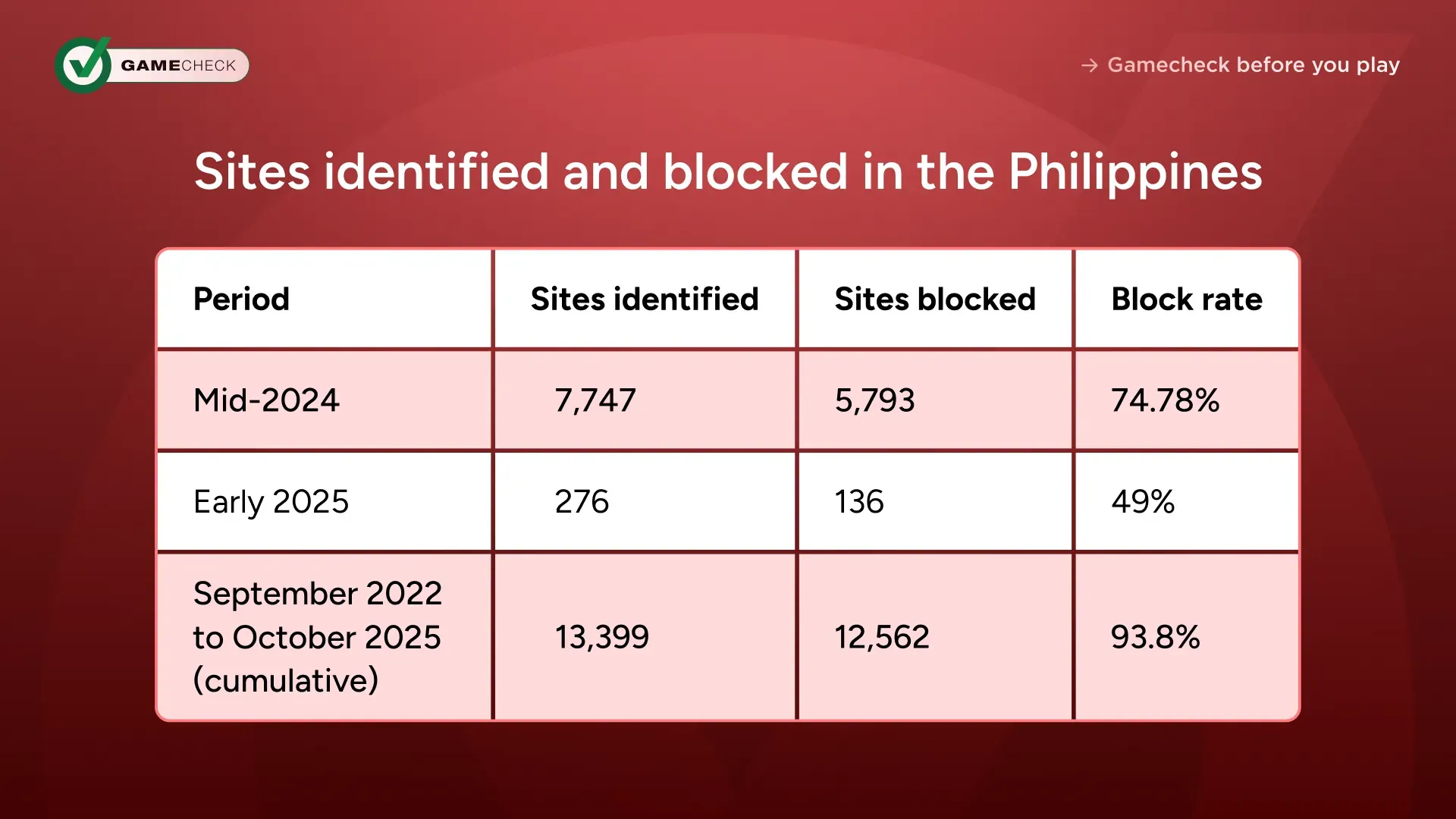
Blocking a site, however, rarely ends the story. PAGCOR can identify sites, but it relies on partner agencies to cut off access. These include the National Telecommunications Commission (NTC), the Department of Information and Communications Technology (DICT), and the Cybercrime Investigation and Coordinating Center (CICC).
The scale of that work is considerable. In February 2026, the CICC said authorities had blocked at least 50,000 online gambling websites, with 95 to 97% operating from outside the Philippines. Yet the number keeps rising, as new platforms appear to replace those taken down.
The bigger challenge is speed. In August 2026, PAGCOR Chairman Alejandro Tengco explained that operators often return quickly after a site is closed, using different methods to avoid being blocked. In many cases, a site simply relaunches under a slightly altered web address.
The size of the market makes it an obvious target. In the first quarter of 2026, the Philippine gaming industry generated gross gaming revenue (GGR) of Php 87.60 billion, about US$1.42 billion. That was down 15.87% from Php 104.12 billion a year earlier.
PAGCOR linked the dip to softer discretionary spending, geopolitical tensions in the Middle East, and rising inflation. Even so, the industry generated Php 396.14 billion across 2025.
The revenue figures explain the market's value, but not why Filipino players are so easily targeted. The answer lies in culture and daily habits more than in any database.
These factors make the market ripe for exploitation. Gambling is culturally familiar, resourcefulness is celebrated, and mobile access removes almost every barrier between a player and a fake site.
Gamecheck exists to make that difference visible, so players can check what they're playing before they deposit any money. The risk with a fake online casino is simple. A game that looks like a well-known slot may not be the provider's game at all. The advertised return to player may not be real, and there's no guarantee a win will ever be paid out.
This is where Gamecheck comes in. We gather evidence from online casinos and check a selection of their games in collaboration with the game providers, who are best placed to confirm whether a game is real.
To date, Gamecheck has completed more than 496,000 checks, and identified more than 10,000 fake online casinos worldwide. Every result is published as a public profile, so anyone can look up a site in seconds using Gamecheck's free tools. Online casinos that offer genuine games can also display the Gamecheck SEAL, giving players a clear signal before they sign up.
Affiliates and review sites share part of this responsibility. Recommending an online casino without checking its games passes the risk straight on to readers. A quick Gamecheck search before a site goes on a list protects the reader and the affiliate's reputation.
The Philippines has a large online gaming audience, and fake online casinos have noticed. They borrow trusted branding, recruit influencers, and recycle domain names faster than they can be blocked. What they can't easily fake is a check against the original game provider. That's the gap Gamecheck exists to close.
Check before you play. Search any online casino on Gamecheck to see whether its games have been checked, and look for the Gamecheck SEAL on online casinos offering real games. It takes seconds, and our free tools are open to everyone.
Published On: Nov 01, 2026
Updated On: Nov 02, 2026
What is a fake online casino?
A fake online casino is a site that offers fake games: copies of popular titles that mimic the original but aren't supplied by the real game provider. Because the operator controls the game's maths, players have no way of knowing whether results are fair or whether winnings will be paid.
Why are fake online casinos targeting players in the Philippines?
The market is large, gambling is culturally familiar, and most players access online casinos through their phones and social media. That combination lets fake sites reach a big audience quickly through influencers, group chats, and recycled domain names.
How does Gamecheck check online casinos?
Gamecheck gathers evidence from online casinos and checks a selection of their games in collaboration with the original game providers. The providers are best placed to confirm whether a game is authentic, and every result is published as a public Gamecheck profile.
What is the Gamecheck SEAL?
The Gamecheck SEAL is a trust badge that online casino operators display to show that Gamecheck has checked a sample of their games in collaboration with the original providers and found them to be real. It carries a domain linked QR code that players can scan using the Gamecheck app to check the seal is real and active.
Join operators using Gamecheck SEAL to protect players and grow credibility.