
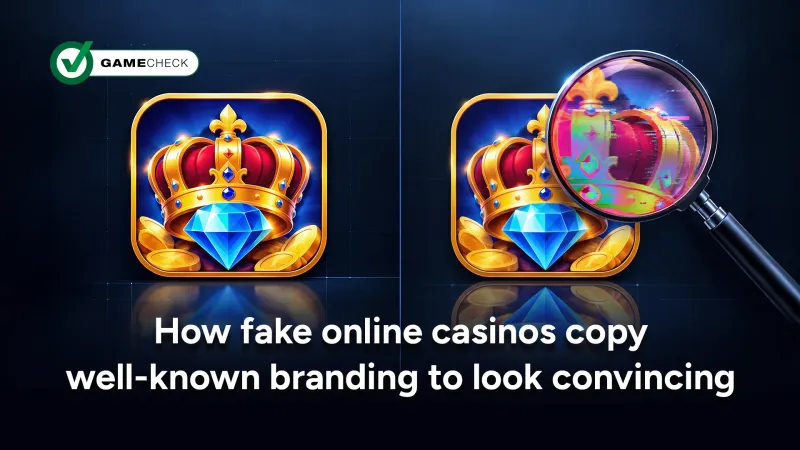
Players often judge an online casino, or a specific game, by how familiar it looks. A polished layout, a recognisable colour scheme, or a logo that resembles a well-known name can create an instant sense of familiarity, often within the first few seconds of landing on a page.
Fake games and copied branding rely on exactly this instinct. Rather than build something entirely new and unfamiliar, many copy the visual signals players already associate with well-established brands, hoping the resemblance alone will be enough to reduce hesitation. Understanding how this borrowing works is a useful starting point for spotting it before it leads anywhere.
This pattern shows up across the industry in small, easy-to-miss details rather than one obvious giveaway. A single copied logo or a single reused screenshot rarely looks alarming on its own. It is only when these details are looked at together, alongside how a game or a site actually behaves once a player starts using it, that the copying becomes clear.
Borrowed branding can appear at almost any level of an online casino or a specific game. A fake site might use a colour palette, font, and page layout that closely echoes a well-known provider or platform, without any real connection to it. Cybersecurity firm Memcyco (2026) notes that copying an operator's branding to redirect players has become a widespread digital impersonation tactic.
A fake game might reuse artwork, character designs, or a name that sits just one letter or word away from a real, well-known title. In some cases, a site displays a badge or seal styled to resemble a standard verification mark, even though no independent check sits behind it.
None of this needs to look amateurish to work. Some copied branding is put together carefully enough to pass a quick first look, a second look, and sometimes a third, particularly when a player is moving between several open tabs or checking a site briefly rather than sitting down to study it.
Players build trust in familiar names and visuals through repeated exposure over months or years. That familiarity becomes a shortcut: a recognisable logo or layout lets someone form a quick impression without stopping to check.
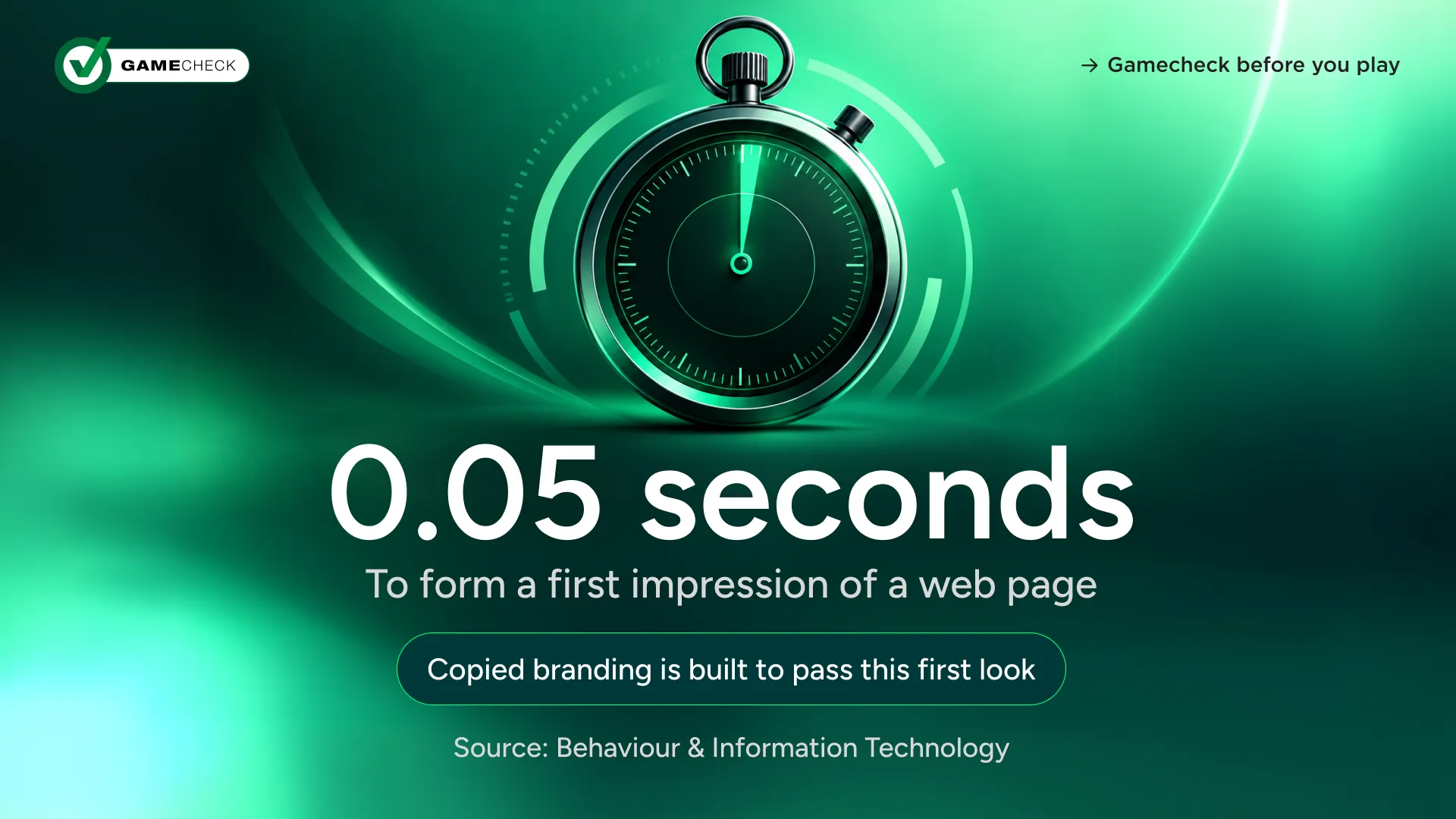
According to research published in Behaviour & Information Technology, users form an initial credibility impression within just 50 milliseconds (0.05 seconds) of landing on a page.
This is the same instinct that makes a copied handbag or a copied watch design convincing at a glance, long before anyone examines the stitching or the movement inside. Fake online casino operators lean on the same shortcut. By borrowing the surface appearance of something familiar, they aim to slip past the moment where a player might otherwise pause and look closer.
This shortcut isn't unique to online casino players. It's how most people navigate an unfamiliar website or app, since checking every visual detail before clicking would make browsing impractical. The difference with an online casino is what's at stake if that quick impression is wrong: time spent playing a fake game, or personal details entered on a page that was never what it claimed to be.
Borrowed branding is a narrower problem than a full clone site, and the two are often confused.
A clone site copies an entire website, domain style included, to sit alongside or replace a real site in search results. The aim is to be mistaken for that specific website.
Borrowed branding can happen without any of that. A completely unrelated site, with its own separate domain and no attempt to imitate the operator's web address, can still carry a copied logo, a reused colour scheme, or game artwork lifted from a well-known title. The aim is narrower: to borrow just enough visual credibility to seem familiar at a glance.
Much of this browsing happens on a mobile device, where compact screens make subtle visual discrepancies, such as a modified logo, or an unfamiliar web address, far easier to overlook. A copied badge or graphic can appear convincing at a glance simply because there is less visual context to evaluate.
Spotting copied branding on a phone requires moving past visual impressions and using purpose-built tools. Rather than trying to inspect minute visual differences on a small screen, players can use dedicated tools like the Gamecheck app to inspect verification marks directly.
None of these tactics require much technical skill. What they rely on is a passing resemblance, close enough to satisfy a quick glance but not built to survive a closer look. A convincing copy does not need to survive close inspection. It only needs to look right for long enough to be trusted.
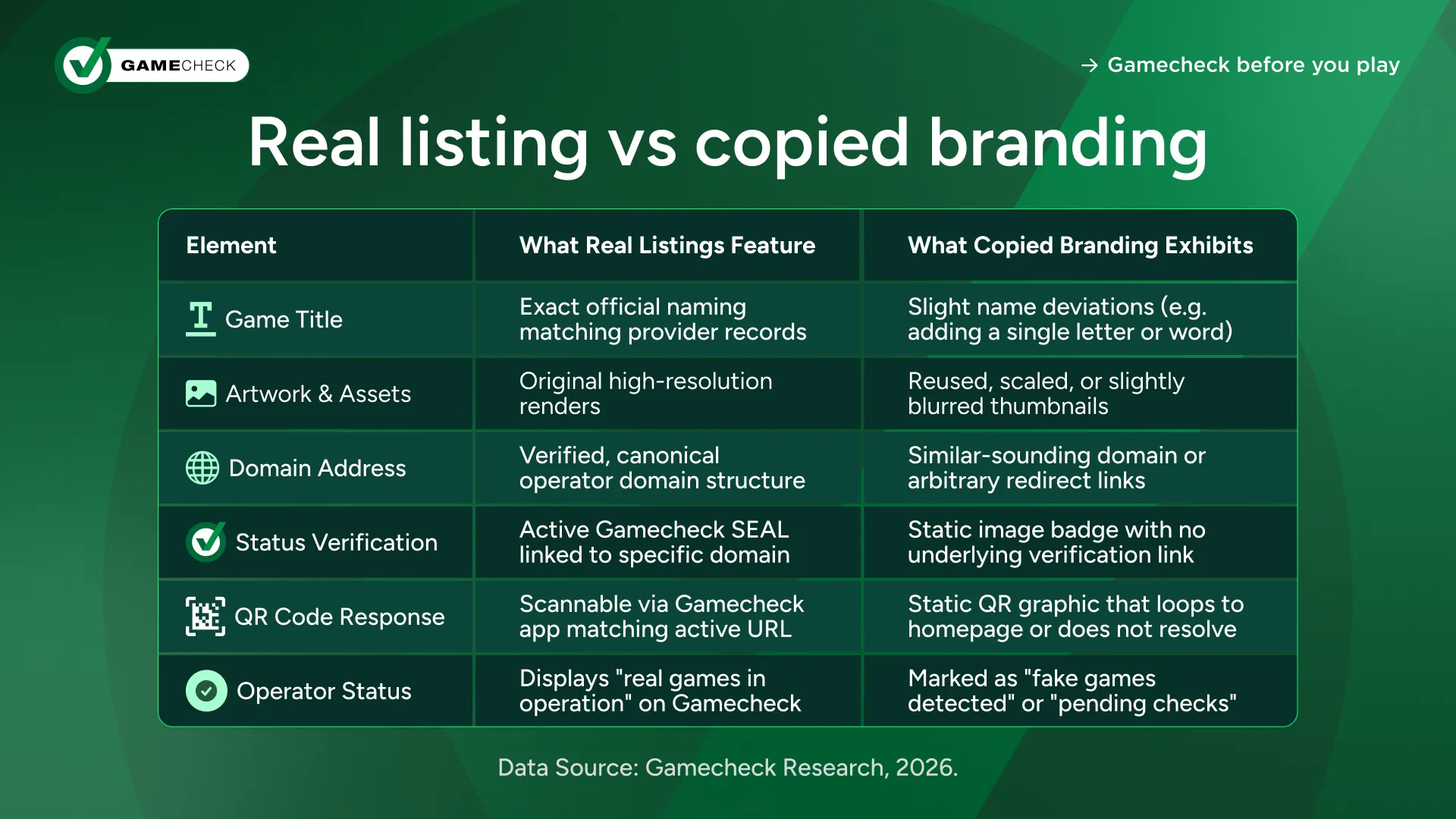
None of the signs below provide certainty on their own. Taken together, though, they are usually enough to justify a closer look before playing.
A close resemblance cannot always be determined by sight alone. A few practical checks help players make an informed decision:
These simple checks replace visual guesswork, helping players determine whether an online casino offers real games.
Borrowed branding does not only affect players.
When a fake game closely copies a well-known title's look, the association can work against the original game provider, even though the provider had no part in creating the fake game.
A player who has a poor experience with a copied game may unknowingly connect that experience with the real provider's name. This kind of copying affects trust across the wider iGaming industry, not just around one fake game. Game providers face a related, quieter cost too: work that took time and investment to design gets reused without permission, diluting the value of the original.
Gamecheck tests games across the iGaming industry to gather evidence and checks these findings directly with partner game providers to determine whether games circulating online are real. Because copied branding rarely announces itself, identifying fake games relies on original game providers examining the artwork, code, and titles in question.
Where a Gamecheck SEAL is displayed on an online casino, it signals that a selection of games has been verified as real by the original game providers. Online casinos displaying the seal are monitored continuously, and the Gamecheck SEAL is removed immediately if fake games are detected afterwards. To date, Gamecheck has evaluated 69,846 online casino sites and completed more than 496,000 individual checks, identifying over 10,000 fake online casinos in the process.
Over time, repeated copying can also make it harder for players to know what a specific well-known title is actually supposed to look like in the first place. If enough imitations circulate, players lose a clear reference point for the real game, which makes future copies even easier to pass off convincingly. This slow blurring effect can end up doing more damage to a game provider's brand than any single copied game on its own.
A familiar look is not the same as a real one, and copied branding is built specifically to blur that difference. As game design and marketing continue to rely on strong, recognisable visuals, the incentive to borrow those visuals without permission is unlikely to fade.
The most reliable response is not to assume familiarity means the real thing, but to check what sits behind it before playing. Nor is this a one-time habit, since branding tactics tend to shift as quickly as players learn to recognise them. Gamecheck is an independent provider of tools, research, and education that helps online casino players determine whether online casinos offer real games.
Published On: Oct 29, 2026
Updated On: Nov 02, 2026
What is borrowed branding?
Borrowed branding is when a fake online casino or fake game copies the visual signals players associate with well-known brands, such as colour schemes, fonts, page layouts, logos or game artwork. The aim is to seem familiar at a glance and reduce a player's hesitation, without any real connection to the original brand.
Why does copied branding work so well on players?
Familiar visuals act as a shortcut, letting players form a quick impression without checking further. Research shows users form an initial credibility impression within 50 milliseconds of landing on a page. Fake online casinos rely on this instinct, borrowing just enough of a familiar look to slip past the moment a player might pause.
How is borrowed branding different from a clone site?
A clone site copies an entire website, including its domain style, to be mistaken for that specific site. Borrowed branding is narrower. An unrelated site with its own separate domain can still carry a copied logo, colour scheme or game artwork, borrowing just enough visual credibility to seem familiar.
What are the signs that an online casino's branding might be copied?
Look out for a logo or layout that looks almost right but is slightly off in colour, spacing or wording, and game artwork resembling a well-known title under an oddly similar name. A badge or seal you can't trace back to its source is another warning sign, as are claims of association that can't be confirmed anywhere else.
How can I check if an online casino offers real games?
The free Gamecheck Search Tool and Chrome Extension both return a clear result in seconds: real games in operation, fake games detected, or a check still pending.
Join operators using Gamecheck SEAL to protect players and grow credibility.