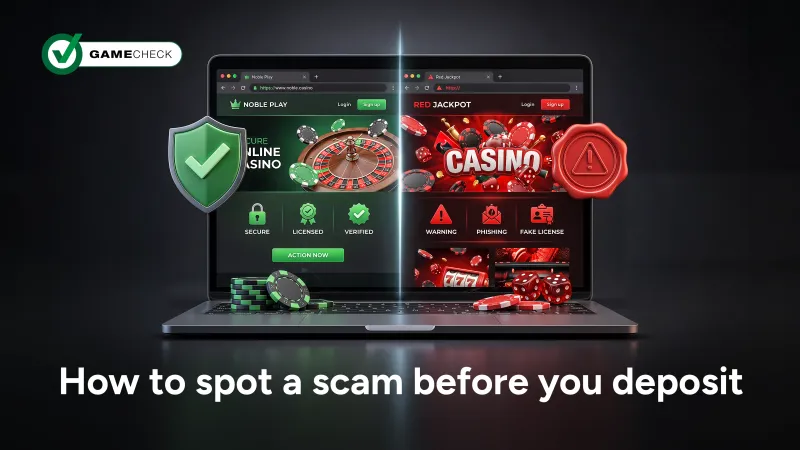
Real-money slots, live dealer tables, and sports betting all offer the same basic promise: an enjoyable way to spend time on online casino gaming, backed by games that behave the way they are supposed to. With thousands of platforms competing for attention, telling a risky operator apart from a well-run one is not always straightforward. Rogue operators lean on the same handful of tactics: misleading promotions, fake or unverifiable licensing details, cloned websites, and payment practices stacked against the player.
The consequences tend to show up later rather than at the point of deposit. Players report stolen financial information, frozen balances, games that do not behave as they were designed to, delayed withdrawals, and spoofed apps built to look like a real online casino brand. Skip the research stage, and a deposit can turn into a financial loss or a stolen identity before the problem becomes obvious.
Every red flag in a fake online casino leaves a data trail. Finding it before depositing, rather than after a withdrawal stalls, makes all the difference. This checklist covers the red flags worth checking, plus the one check most guides leave out entirely.
Online casino gaming is growing fast, and growth attracts scale, including at scale for rogue operators. Gamecheck's own database has recorded more than 10,000 fake games identified worldwide since monitoring began, with 43,500 online casino sites monitored and 257,600 checks completed to date. This is enough data to show that scam sites follow recognisable patterns.
Look at the website first. A domain that mimics a known brand, a missing secure padlock in the address bar, or games that take an unusually long time to load are not isolated glitches. They are the technical fingerprints of a site built to catch traffic rather than earn it. Slow-loading games in particular are often a sign that the operator is using an unlicensed clone or a copy of the game rather than the certified version, since clones are typically hosted on lower-quality infrastructure without proper optimisation or testing.
The same goes for unsolicited bonus offers arriving by email, text, or WhatsApp. A player who clicks a link from an unexpected message is skipping the one step, checking the domain independently, that catches most scam attempts before a deposit is made.
Clone apps work the same way. Some sites offer app downloads outside the official app stores, through third-party profiles. These apps often look identical to a known brand, but collect banking details entered during deposit. Combined with a domain registered only weeks ago, broken links, and clumsy translations, the pattern points to a site built fast, run briefly, and shut down once negative reviews start piling up.
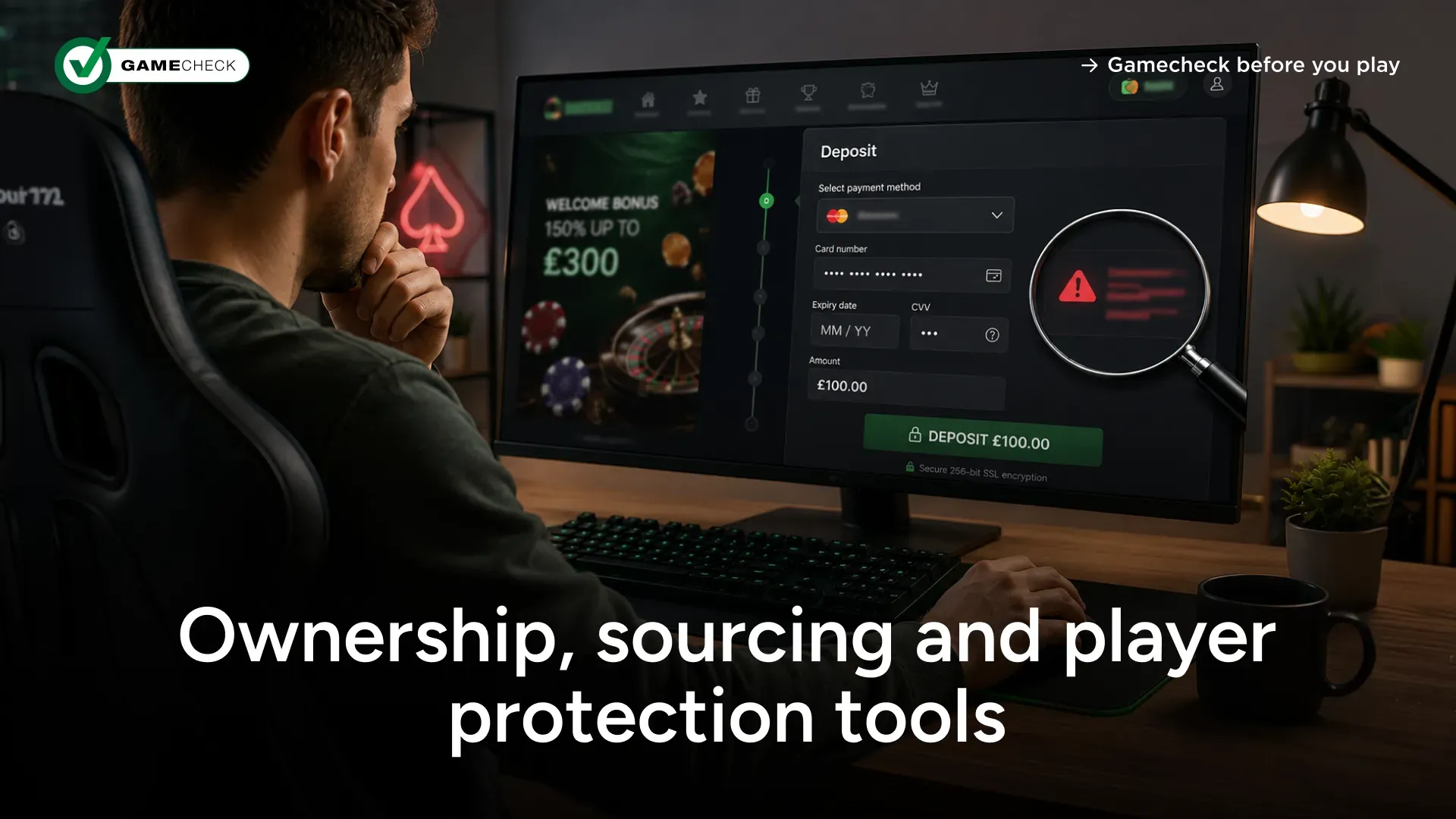
A site's footer should answer three questions, and most scam operators leave at least one blank. The first is who runs the site. A well-run online casino names its parent company, gives a real business address, and lists an executive team somewhere in the footer or an "about us" page. A platform with no identifiable business entity behind it leaves players with nowhere to go if a dispute arises or the site closes down.
The second is where the games come from. A well-run operator makes clear that its games are sourced through official, provider-backed channels. An unbranded games lobby, with no indication of where the content originates or how it reached the site, is one of the clearer signs that the software behind it may not be what it claims to be.
The third is whether the site takes player protection seriously. Session timers, deposit limits, and self-exclusion options are standard on platforms that take player welfare seriously. Their complete absence is not a minor omission. It suggests an operator with little interest in how players are affected by their own habits, which tends to correlate with a broader disregard for player interests elsewhere on the site.
A site's footer is a dataset in itself, and most players never scroll far enough to read it. A recognised online casino operator will display a license number issued by a body such as the UK Gambling Commission (UKGC), the Malta Gaming Authority (MGA), the Gibraltar Regulatory Authority (GRA), the Isle of Man Gambling Supervision Commission, the Alderney Gambling Control Commission (AGCC), the Kahnawake Gaming Commission, the Government of Curaçao, or the Alcohol and Gaming Commission of Ontario (AGCO), depending on where the operator is based. A license number alone proves little. Cross-checking that number on the regulator's own website, to confirm it is active and matches the operator's name, takes a couple of minutes and closes off one of the more common places scam sites cut corners.
Independent testing certification adds a second, separate data point. Accredited labs such as eCOGRA, iTech Labs, and Gaming Labs International (GLI) audit operators to confirm fair outcomes and unbiased results across the platform. A site displaying no testing certification at all, alongside a missing or unverifiable license, is compounding one gap with another.
A welcome offer is a number with conditions attached, and the conditions matter more than the headline figure. A wagering requirement set at 100 times the combined deposit and bonus is not a generous offer. It is a mathematical barrier. Run the calculation: at a typical online slot's return rate, a player would need an improbable run of results to clear that playthrough before the balance runs out. The bigger the advertised bonus, the more scrutiny the fine print deserves, not less.
Promises of certain returns or foolproof strategies fail the same test. Online casino gaming carries built-in uncertainty, by design, on every real platform. Any operator claiming otherwise is making a statement that contradicts how the underlying games work, which is itself a useful signal.
Loyalty and VIP schemes deserve the same scrutiny as a headline bonus. A well-structured programme sets out clearly how points convert into rewards. A scheme built around vague rates and rewards that never quite materialise is designed to keep high-spending players engaged without ever paying out what was implied.
Withdrawal data tells you more about an operator than almost anything else on the site. A minimum cashout threshold set unusually high, well beyond what a typical player would reach, functions as a mechanism to keep funds in play rather than a policy choice. Processing delays that stretch to weeks, with no clear explanation, are worth comparing against how quickly the same site accepted your deposit. A gap that large between deposit speed and withdrawal speed is not a coincidence.
Fees that surface at the point of withdrawal, after never being mentioned at the point of deposit, follow the same logic. So does a site that changes its terms retroactively, after funds are already committed. Identity checks follow a similar pattern when they are used against the player rather than for security. A site that lets deposits through with no friction, then introduces lengthy requirements once a withdrawal is requested, is likely using the process to delay a payout rather than to confirm who the customer is.
Independent reviews and player forums are, in effect, a distributed dataset built by people who already went through the process a new player is about to start. A cluster of unresolved complaints about frozen balances or withheld winnings is a stronger signal than any single review, since it shows a repeated outcome rather than one bad experience. A support channel that only offers scripted chatbot responses, with no route to a human when a withdrawal dispute arises, adds another data point in the same direction.
A sudden increase in unsolicited marketing, through SMS, email, or direct messages, after signing up with a site is worth noting too. It often indicates that personal details have been shared or sold on without the player's knowledge, which raises separate concerns about how the rest of that data is being handled.
Every check above, license, testing certificate, ownership details, bonus terms, banking behaviour, reputation, can be run without loading a single game, and a site can pass all of them while still running fake games behind a real-looking interface.
This is the gap in most red-flag research, and it is the variable Gamecheck exists to measure. A valid license and a working support chat say nothing about whether the slot on screen is sourced from the original game provider or a copied build designed to behave differently.
Gamecheck checks a selection of games in collaboration with the original game providers, who are best placed to confirm whether the games are real or fake. Of the fake games identified so far, a recurring pattern holds across markets: sites offering the fastest-growing regions the highest bonuses tend to carry the highest concentration of fake games, which tracks with where rogue operators expect the least scrutiny.
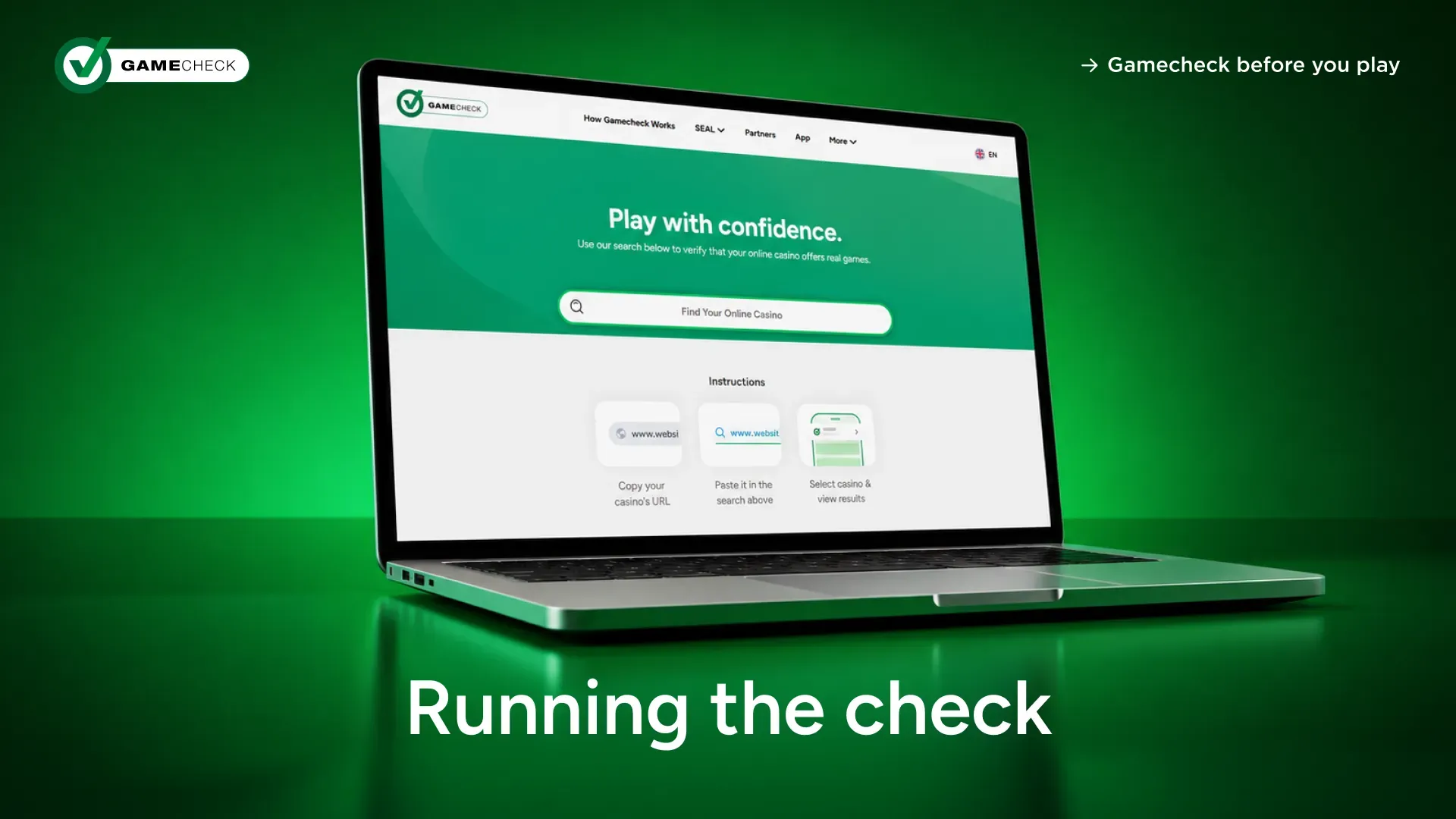
Type or paste the domain into the Gamecheck Search Tool, or run the same check through the Gamecheck app on mobile. The result returned is one of three states: real games, fake games, or pending checks, meaning the site has not yet been reviewed. If a domain has no result at all, it can be reported directly through the search tool to begin the review process.
An active Gamecheck SEAL displayed on a site is a further data point, but only once scanned. Scanning the SEAL's QR code through the Gamecheck app confirms it is linked to that specific domain rather than lifted from another site, since a copied SEAL is identified and exposed as soon as it is detected.
Individually, each of these takes under a minute. Run together, they close most of the gap that scam operators depend on, and they add the one check, whether the games themselves are real, that the rest of the industry's red-flag guidance often leaves out.
Before you deposit anywhere new, check the domain's URL using the free Gamecheck Search Tool, and look for an active Gamecheck SEAL to see whether the games on offer are real.
Published On: Sep 15, 2026
Updated On: Sep 18, 2026
What does a high wagering requirement actually mean for a bonus?
A wagering requirement sets how many times a deposit and bonus combined must be played through before any winnings can be withdrawn. A requirement set at 100 times that combined amount is a mathematical barrier rather than a generous offer, since clearing that much playthrough before the balance runs out is unlikely at a typical slot's return rate. The larger the bonus, the more the terms deserve a close read.
How does the Gamecheck Search Tool decide whether a site's games are real or fake?
Gamecheck gathers evidence and checks a selection of games in collaboration with the original game providers, who confirm whether the games are real or fake. Typing a domain's URL into the free Gamecheck search tool, or running the same check through the Gamecheck app, returns one of three results: real games, fake games, or pending checks, meaning the site has not yet been reviewed.
Can I download a casino app from outside the official app store?
No. Apps distributed outside the Google Play Store or Apple App Store skip the review process each store applies to every listing. A downloaded APK file or a third-party iOS profile can install an app built to look identical to a known brand, while quietly collecting banking details entered during a deposit. Stick to official app stores, or use the Gamecheck app instead.
Join operators using Gamecheck SEAL to protect players and grow credibility.