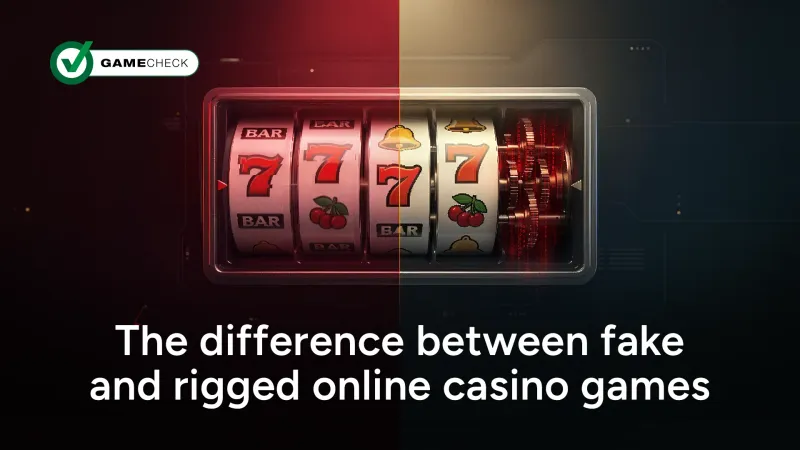
Online casino players have often asked us: what is the actual difference between a fake game and a rigged game? It is a fair thing to ask, since both end with a player losing money on unfair terms. This article sets out to answer that question, so players have a more complete picture of what they're checking, and why Gamecheck's approach to fake games covers more ground than checking for rigging alone.
A fake game is a copy of a real game that never came from the original provider in the first place. Fake games imitate the branding, graphics, and names of legitimate titles, but they run on unknown infrastructure with no certified RNG and no audited RTP behind them at all.
Where a real game is built and hosted by the provider whose name it carries, a fake game is built by whoever chooses to copy it, using nothing more than what is visible on screen: the reels, the symbols, the sound, the layout. None of that requires access to the provider's actual software, only a convincing enough reproduction of it.
This matters most at the point where money changes hands. A fake game exists to bring players in and encourage deposits, not to pay out fairly, and in many cases not to pay out at all. Because there is no real provider standing behind it, there is no accountability forcing a pay-out to happen. Winnings shown on screen can be withheld, delayed, or simply never paid, and the player has no real provider or regulator to turn to, since the game they were playing was never real to begin with.
Most online casino games run on a random number generator, or RNG, the software that decides the outcome of each spin, hand, or round. Legitimate providers submit their RNGs for independent testing by bodies such as eCOGRA, iTech Labs, or Gaming Laboratories International, and the resulting return-to-player rate, or RTP, is built into the certified software from that point on. Real slot titles typically carry an RTP somewhere between 92% and 98%, published openly by the provider.
Rigging means the mechanics behind that certified process have been interfered with, so the odds are shifted firmly in the house's favour. In these cases, the game may still trace back to a real, recognisable title, built by a genuine provider. The software exists, and the site may pay out when a player wins. What has been altered is the likelihood of that ever happening: the mechanics are tilted so heavily against the player that a real win becomes effectively impossible.
A rigged game is a real game gone wrong. A fake game was never real to begin with, so it carries every risk a rigged game carries and more: no accountability sitting behind the numbers on screen at all. Checking whether a game is fake automatically covers whether it could be rigged, because a game with no legitimate provider behind it has failed the fairness test before rigging even becomes a relevant question.
Understanding why fake games are so widespread helps explain why they are worth checking for specifically. Building a fake game does not require much more than copying what already exists. Operators running fake games can reproduce the graphics, sound, and layout of a popular title closely enough that most players would not notice the difference, then set the pay-out behaviour to whatever suits them, since there is no real provider, licence, or audit involved.
That approach is also cheap to run at scale. Without a licensing agreement to a real provider, there are no royalty costs, no geographic restrictions on who can access the game, and no regulator checking in. A single cloned title can be deployed across dozens of near-identical sites, often sitting behind domain names that are slight misspellings of real casinos or well-known brands, alongside fabricated licensing documents or copied trust seals designed to look convincing at a glance.
None of this requires the operator to be particularly sophisticated. It requires only that the copy looks convincing enough for a player not to check further, which is the gap Gamecheck's process is built to close.
Rather than trying to detect subtle manipulation inside an otherwise legitimate system, Gamecheck checks whether the games on a site are real in the first place, working directly with the original game providers to confirm it. That is a more thorough check than looking for rigging alone, because it catches every fake game regardless of whether the fairness problem inside it is due to rigging or poor odds. If a site is offering fake games, no amount of RTP transparency or certification claims on the page changes that underlying fact.
There is no need for a player to become a forensic analyst before placing a bet.
A few checks go a long way:
A losing streak is not, on its own, proof that anything is wrong. Randomness is a normal part of any game, and even a perfectly fair game can produce a long run of losses. Asking "is this game rigged?" only gets a player partway to safety, because it assumes a real game is sitting underneath the question. On a site offering fake games, no amount of studying odds will change what is happening behind the screen.
The more useful question, and the one worth asking before a deposit rather than after a loss, is whether the game is real at all. Gamecheck's free tools make that simple: paste a link into the free search tool to see whether the games on offer on any online casino are real games. Always Gamecheck before you play.
No. A fake game never came from a real provider in the first place, so there is no certified RNG or audited RTP behind it at all. A rigged game does trace back to a real, recognised provider, but the mechanics behind its certified RNG have been interfered with so the odds sit heavily against the player.
Yes. A real provider's name on a game does not rule out interference further down the line. If the mechanics behind a certified RNG have been tampered with, the odds can be shifted firmly in the house's favour, even though the underlying title is a real release from that provider.
Gamecheck checks whether the games on a site are real in the first place, in collaboration with the original game providers. This covers rigging too, since a real game found to have been tampered with is classed as a fake game as well. Checking for "real or fake" catches both problems in a single check.
Published On: Sep 10, 2026
Updated On: Sep 14, 2026
Join operators using Gamecheck SEAL to protect players and grow credibility.