Brazil has banned online casino gaming and sports betting.
On 25 September 2026, President Luiz Inácio Lula da Silva signed an order that ends both across the country, according to iGaming Business.
The ban affects every player in Brazil. Three things change straight away:
When those sites go offline, millions of players will open a familiar app and find nothing there. Many will soon be sent a new link instead: a "new platform", a promise that this one still pays.
The ban only closes the licensed market. Fake online casinos never had a Brazilian licence, and they will not close on 6 October. Instead, they may try even harder to reach Brazilian players. If what Gamecheck found before the ban is any guide, some of those new links will lead to unregulated online casinos running fake games, where whoever runs the site sets the pay-outs. Players who move to these sites face a higher risk.
"The licensed sites switch off on 6 October, and new links are already appearing. In the first half of this year alone, we found fake games on 5,000 sites targeting Brazil. Players deserve to know what they are clicking on." Fred Azevedo, Brand Ambassador for Latin America, Gamecheck
This article explains what the ban means, why the government made this decision, what could happen next, and why checking sites with Gamecheck matters now.
Brazil's betting ban has been in force since 25 September 2026 under Medida Provisória nº 1.394/2026, a provisional measure (MP) signed by the President.
The provisional measure bans sports betting and online casino games, including from operators based abroad. After 6 October, every site taking bets from Brazil is unregulated, with no games certified for Brazil, no Brazilian regulator, and a higher risk of fake games.
A provisional measure has the force of law from the moment it is published. The MP bans operating, offering, brokering, and advertising fixed-odds betting anywhere in Brazil, online and offline. It covers sports betting and online casino games, and it applies even when the operator is based abroad. Lotteries authorised by law, such as Mega-Sena, Lotofácil, and Quina, are not affected.
The ban ends Brazil's licensed betting market after about 21 months. According to the government, Brazil's betting regulator, the Secretaria de Prêmios e Apostas (SPA), had granted 85 licences covering around 180 brands. The SPA says 25.2 million people bet with licensed operators in 2025.
The government gave several reasons for the ban.
Families in debt. The government said many Brazilian families had fallen into debt because of betting. Brazil's central bank estimated that Brazilians spend about R$ 30 billion on bets every month. Finance Minister Dario Durigan called betting a public health problem.
The rules did not work. The government had created rules to protect families. Durigan said those rules had not worked well enough.
Addiction. Minister Durigan spoke about serious cases of addiction. President Lula told the story of a young man who had tried to end his life three times because of betting. "I decided to take a necessary, tough, and drastic measure," he said.
Football clubs. Lula said Brazilian football clubs depend too much on money from betting companies. In 2025, top clubs received US$ 212 million from betting companies, according to a Globo report.
The political context. The order was signed just over a week ahead of the first round of the presidential election. Polls suggest a ban enjoys widespread endorsement among Brazilians.
Anyone in Brazil affected by the issues raised in this article can contact CVV (Centro de Valorização da Vida) free of charge on 188, 24 hours a day.
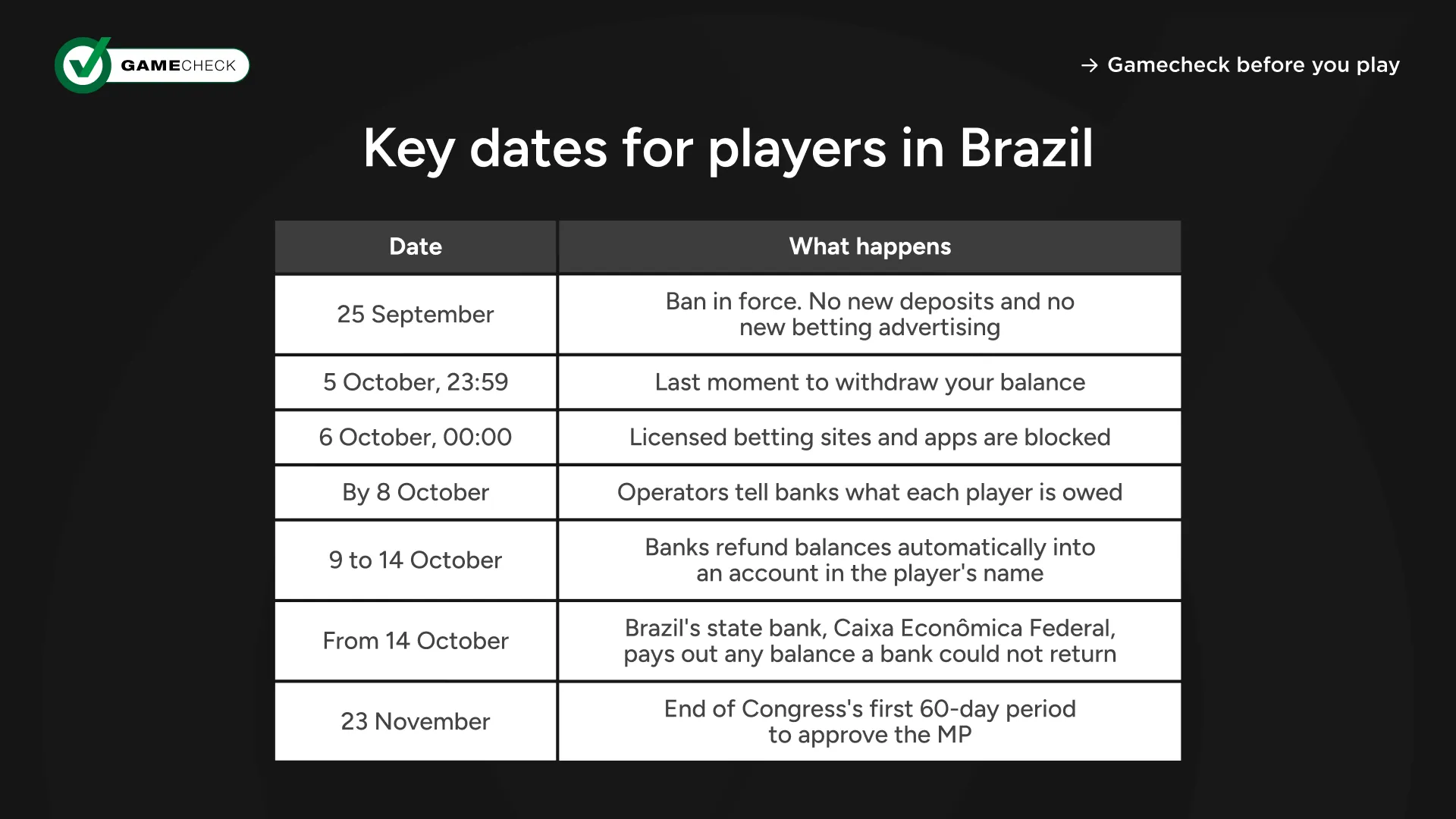
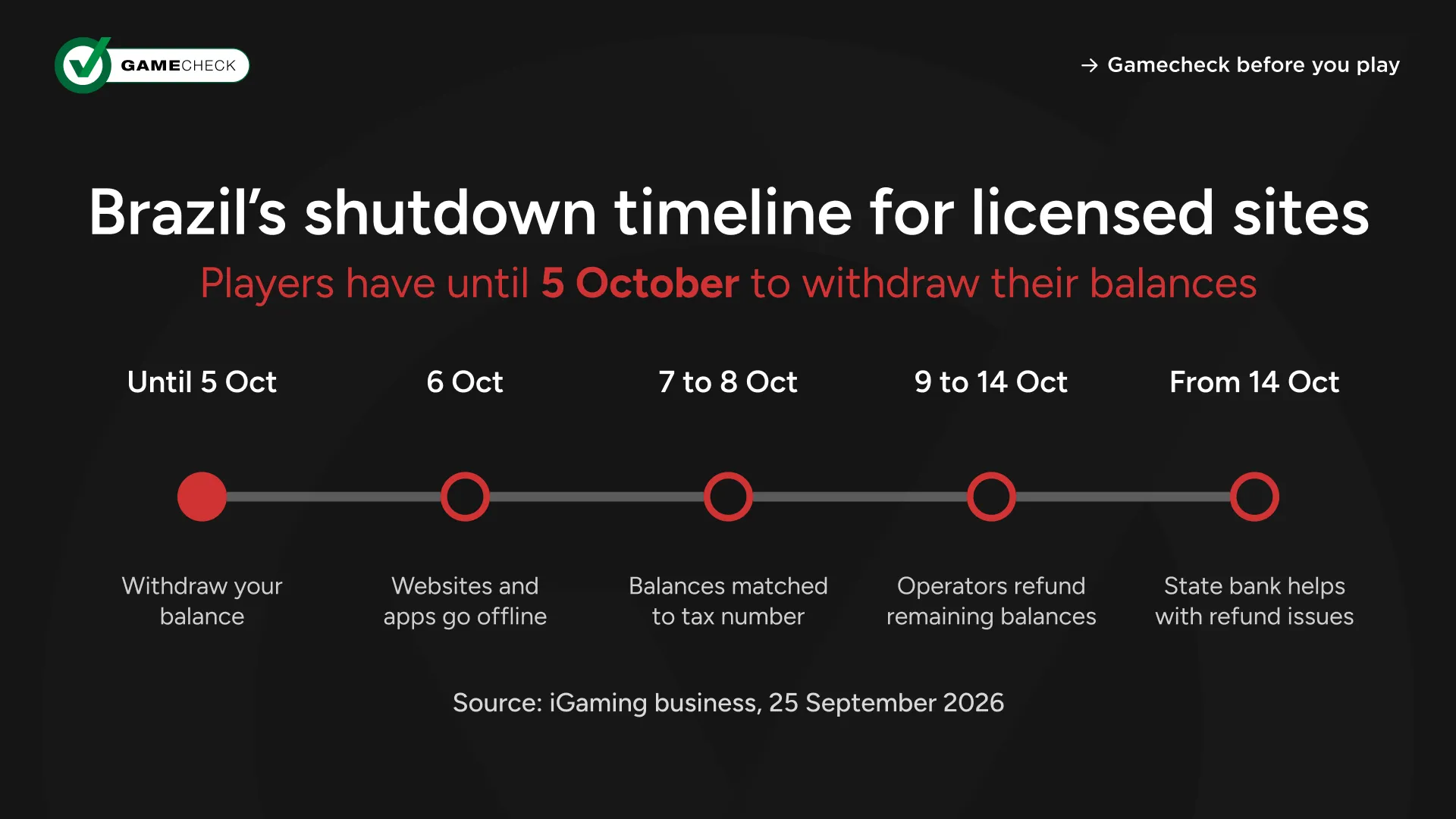
Withdraw before 23:59 on 5 October.
You can still log in to a licensed site and take out your available balance until the deadline.
If you miss the deadline, the refund is automatic.
Operators must tell the banks what each player is owed, using the Brazilian taxpayer number (CPF) you registered with. Banks then refund the full amount into an account in your name. You do not need to ask for it, and a real refund never involves paying a fee. If anyone asks for a fee, a password, or a code to release your refund, it is a scam.
Bets that have not been settled by the shutdown are cancelled, and your full stake comes back. The MP does not say what happens to bonus balances. Keep screenshots of your balance, bet history, and deposits until the money arrives.
These rules only protect money held with licensed operators.
Money held with an unlicensed site has no protected refund route.
The provisional measure is aimed at operators, advertisers, payment companies, and internet platforms. It sets no penalty for individual players. The government has drafted a separate bill with prison sentences for anyone who runs or promotes a betting site. Press reports say it does not propose prison for simply placing a bet. Nothing in the ban makes betting offshore legal, though.
A 1941 law already allows fines for taking part in games of chance, including online, and no official source has said players are exempt. This is general information only. If you are worried about your own position, speak to a qualified lawyer in Brazil.
The government can block a website in hours. The players who used it are still out there. Whether the ban is the right policy is for Brazilians, Congress, and the courts to decide. Gamecheck's concern is the games players meet if they keep playing.
The illegal market was already large. Before the ban, estimates of Brazil's illegal market ranged from about 30% to more than half of all betting. In a May 2026 audit, Brazil's federal audit court, the Tribunal de Contas da União (TCU), put illegal operators at 41 to 51% of betting volume, worth up to R$40 billion a year.
A study commissioned by the Instituto Brasileiro de Jogo Responsável (IBJR), a licensed industry body, put the illegal share at 38 to 44% in the first half of 2026.
New sites are appearing fast. The monitor Bet Legal, working with Iron Security, counted 415 new unauthorised betting sites in about two days after the ban was announced, as reported by The Rio Times. The monitor is linked to the licensed industry, which opposes the ban, and its count does not prove the sites are fraudulent. It does suggest that new sites are moving quickly to fill the gap.
Social media points the same way. A PUC-Rio analysis of more than 55,000 accounts, published in September 2026, found that 84% of the betting operators Instagram recommends most are unauthorised. Before the ban, between 1 and 24 September, the Justice Ministry's public security department (Senasp) had already removed 1,367 Facebook and Instagram pages and profiles promoting irregular betting.
Analysts expect this movement to grow. Regulus Partners, quoted by the Racing Post, said the black market would be "by far the biggest winner" of the disruption. Flávio Ataliba, an economist at the Fundação Getulio Vargas economics institute (FGV Ibre), told InfoMoney that the people who move to illegal sites are those who bet most compulsively.
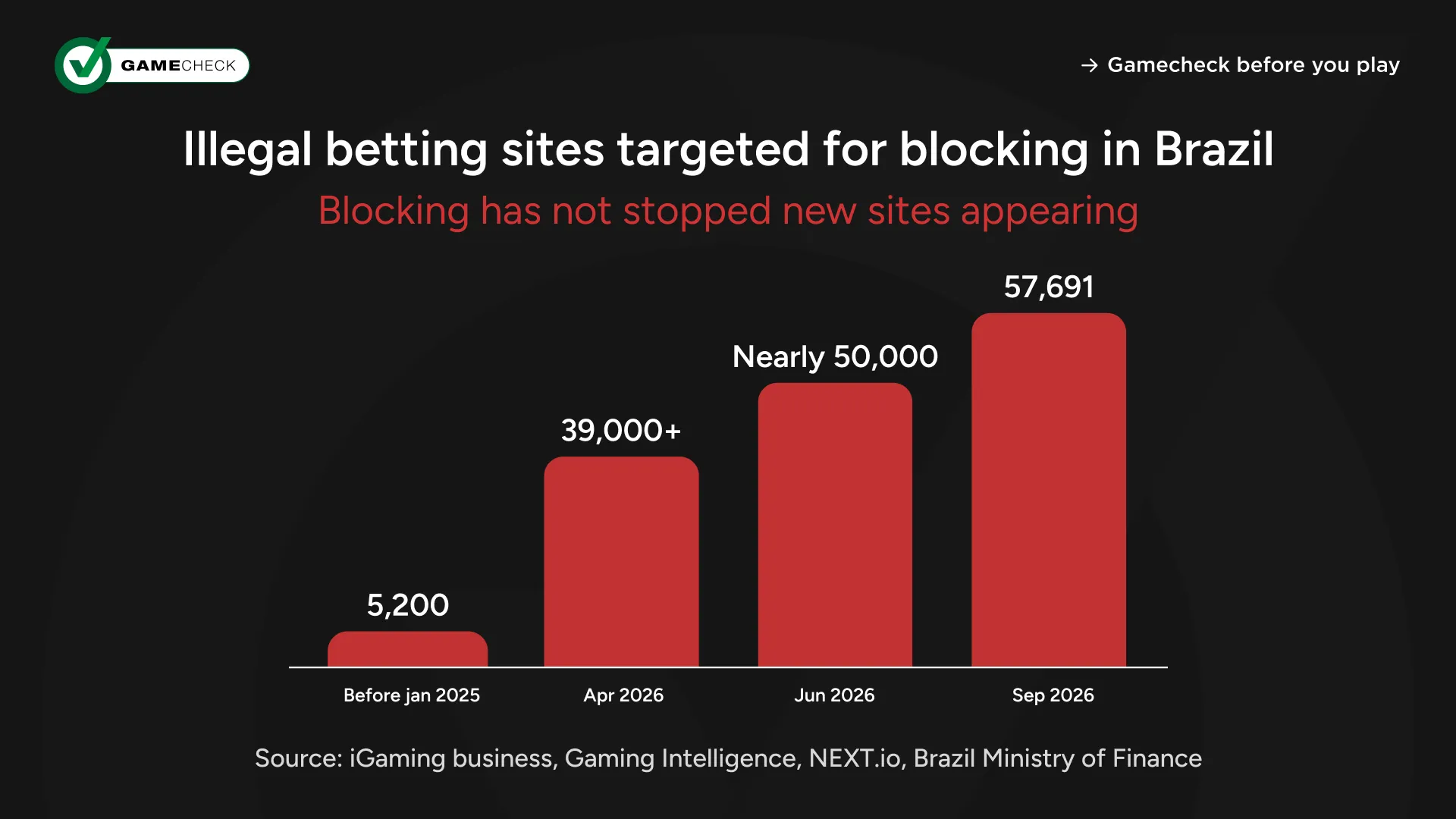
Brazil has been blocking illegal sites for years. More than 5,200 had been blocked before the licensed market opened in January 2025. By April 2026, that figure had passed 39,000, and by June the SPA had asked for nearly 50,000 to be blocked. By 22 September 2026, the Finance Ministry had sent 57,691 addresses to Brazil's telecoms regulator, Anatel, for blocking this year. Blocked sites often return on new domains.
Brazil's licensed market had its flaws, but every operator had to follow clear rules:
An unregulated online casino owes players none of this. No local regulator checks its games, its pay-outs, or how it handles players' money and data.
A fake game is a copy of a real game that never came from the original provider. It copies the name, the artwork, and the layout. On screen, players cannot see the difference. But whoever runs the site controls the maths behind it, so the operator can set the payouts however it likes, and winnings shown on screen may never be paid.
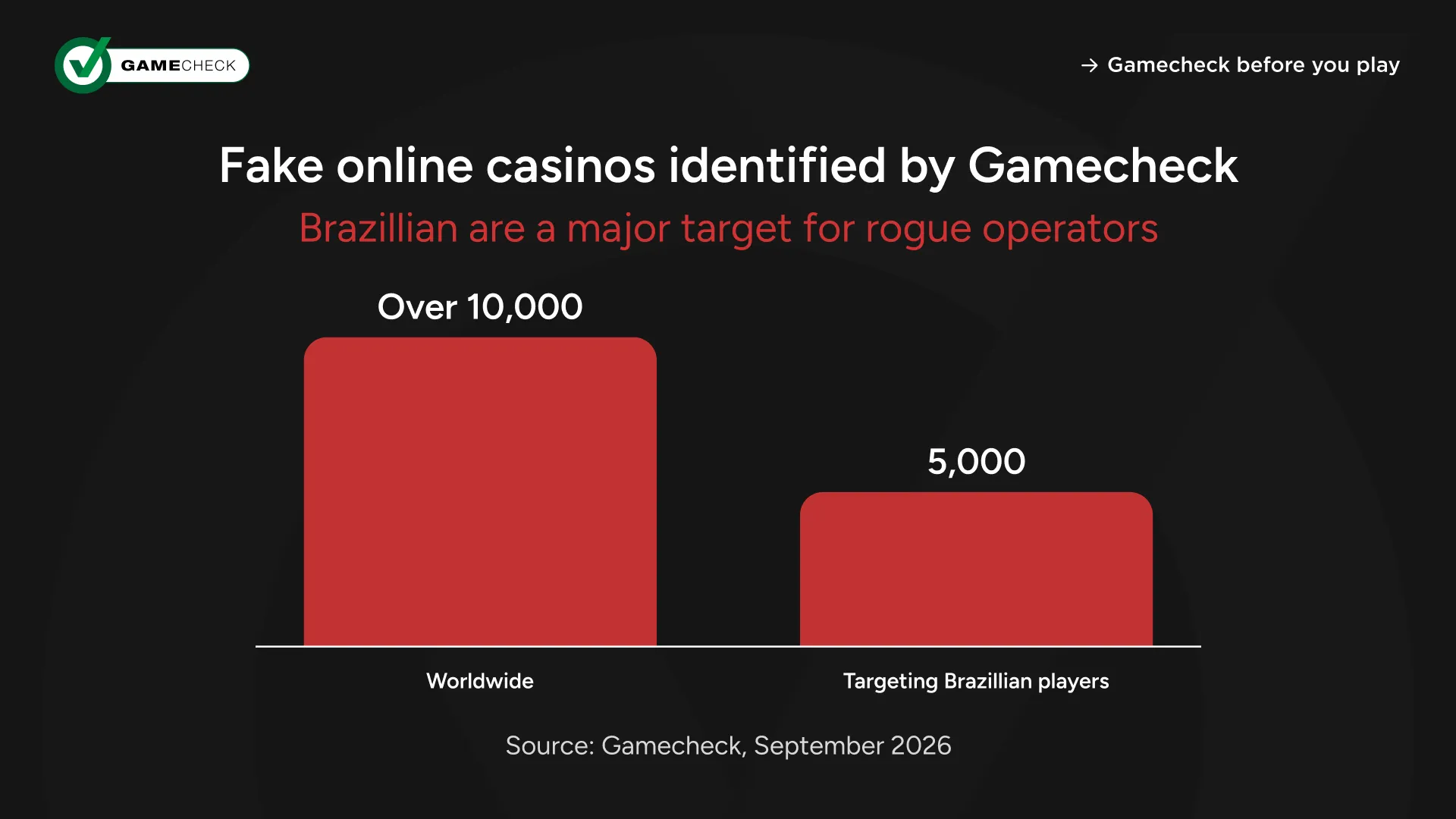
In July 2026, Gamecheck reported that it had identified 5,000 fake online casino sites targeting Brazilian players in the first half of the year. Gamecheck launched a ten-part Brazil exposé series, published weekly from 20 July to 21 September 2026, exposing 50 fake online casinos in each instalment.
The same patterns kept coming back: short domains made of random letters and numbers, polished visuals, repeated templates, and sites relaunching within days. Gamecheck monitors 69,846 online casino websites, has completed more than 496,000 checks, and has identified over 10,000 fake online casinos.
Brazilian-facing online casinos where Gamecheck has detected fake games include:
Gamecheck tests a selection of games on each site, collects evidence such as screen recordings, and checks its findings with the original game providers, who are best placed to confirm whether a game is real or fake.
From 6 October, the risk rises for three reasons:
Gamecheck is here to protect players. As well as exposing fake online casinos, Gamecheck helps players recognise online casinos that offer real games. It does this through the Gamecheck SEAL.
An online casino can only display the Gamecheck SEAL after passing checks on its games. Each Gamecheck SEAL is live and linked to one specific website. Players can scan its QR code with the free Gamecheck app to make sure it belongs to the site they are on.
If fake games are found on a site after it receives the Gamecheck SEAL, Gamecheck removes it straight away. The operator cannot apply again for 12 months. Every action is recorded publicly, so players can see it.
The Gamecheck SEAL shows that an online casino offers real games. It does not mean the site holds a Brazilian licence. From 6 October, no online casino will be licensed to operate in Brazil.
If you have been sent a new link on WhatsApp, or told that a site you used has moved to a new address, check it before you tap it or share any details:
Each result falls into one of four states:
If a site is not listed yet, you can ask Gamecheck to check it.
A result describes the games Gamecheck tested on a site, at the time it tested them. It is not a recommendation to play. From 6 October, no site may legally take bets from players in Brazil, with or without a Gamecheck SEAL. The best way to protect your money is to withdraw your balance before 5 October and not deposit anywhere new.
Even if the ban is overturned, licensed sites are unlikely to return overnight.
For players, the next few months are likely to be the riskiest.
Download the free Gamecheck app to check any online casino before you play.
This article draws on the text of Medida Provisória nº 1.394/2026, official announcements from the Brazilian government and the Ministries of Justice and Finance, and reporting by Agência Brasil, Reuters, AP, iGaming Business, The Rio Times and others. Industry figures are labelled as such. Gamecheck's figures come from its Brazil exposé series, published weekly from 20 July to 21 September 2026.
Key sources:
Published On: Sep 27, 2026
Updated On: Nov 03, 2026
-400x225.webp)
-400x225.webp)
Is online betting legal in Brazil?
No. Since 25 September 2026, Medida Provisória nº 1.394/2026 has banned sports betting and online casino games, from licensed and offshore operators alike. Lotteries authorised by law, such as Mega-Sena, remain legal.
Do I need to request a refund?
No. Refunds from licensed operators are automatic and arrive between 9 and 14 October 2026 in a bank account in your name. If a message asks for a fee, a password, or a code to unlock a refund, treat it as a scam.
What if an offshore online casino will not pay my winnings?
You may have no way to get the money back. Brazil's refund rules only cover licensed operators, and there is no Brazilian complaint channel for unlicensed sites.
Is Brazil's betting ban permanent?
Not necessarily. Congress must approve the MP, or it lapses, and industry groups plan to challenge it at the Supreme Federal Court (STF).
How can I check an online casino for fake games?
Paste the site's address into the Gamecheck Search Tool or the free Gamecheck app. If the site has not been checked yet, you can ask Gamecheck to check it.
Join operators using Gamecheck SEAL to protect players and grow credibility.