
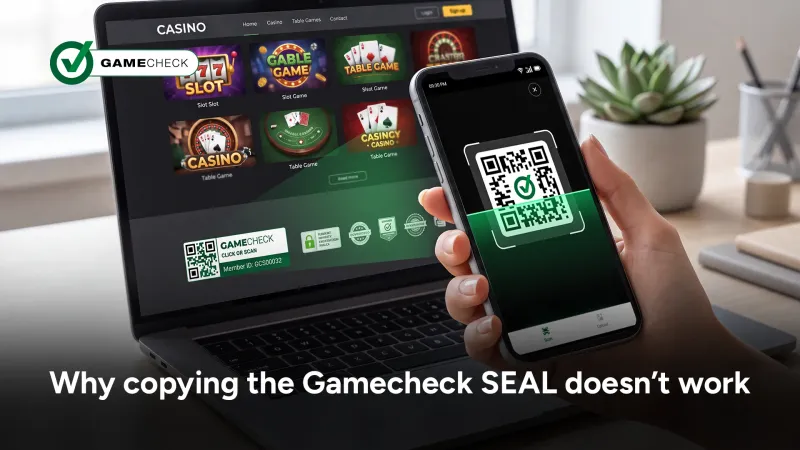
A badge sitting on an online casino website is a picture. A picture can be saved, copied, and placed on a completely different site in a matter of seconds, which is exactly how some operators borrow a badge they have no real claim to. The Gamecheck SEAL is built to resist that particular trick. What makes the difference is not how the Gamecheck SEAL looks, but what happens when a player actually scans it, rather than simply trusting it on sight.
An image file does not know where it is being shown. Anyone can right-click a badge graphic, save it, and paste it onto an unrelated site, where it will look identical, because nothing in a static image ties it to one specific site. A player glancing at the page cannot tell the original from the copy. The copy does not need to be sophisticated to work. It only needs to sit where players expect a trust badge and look the part.
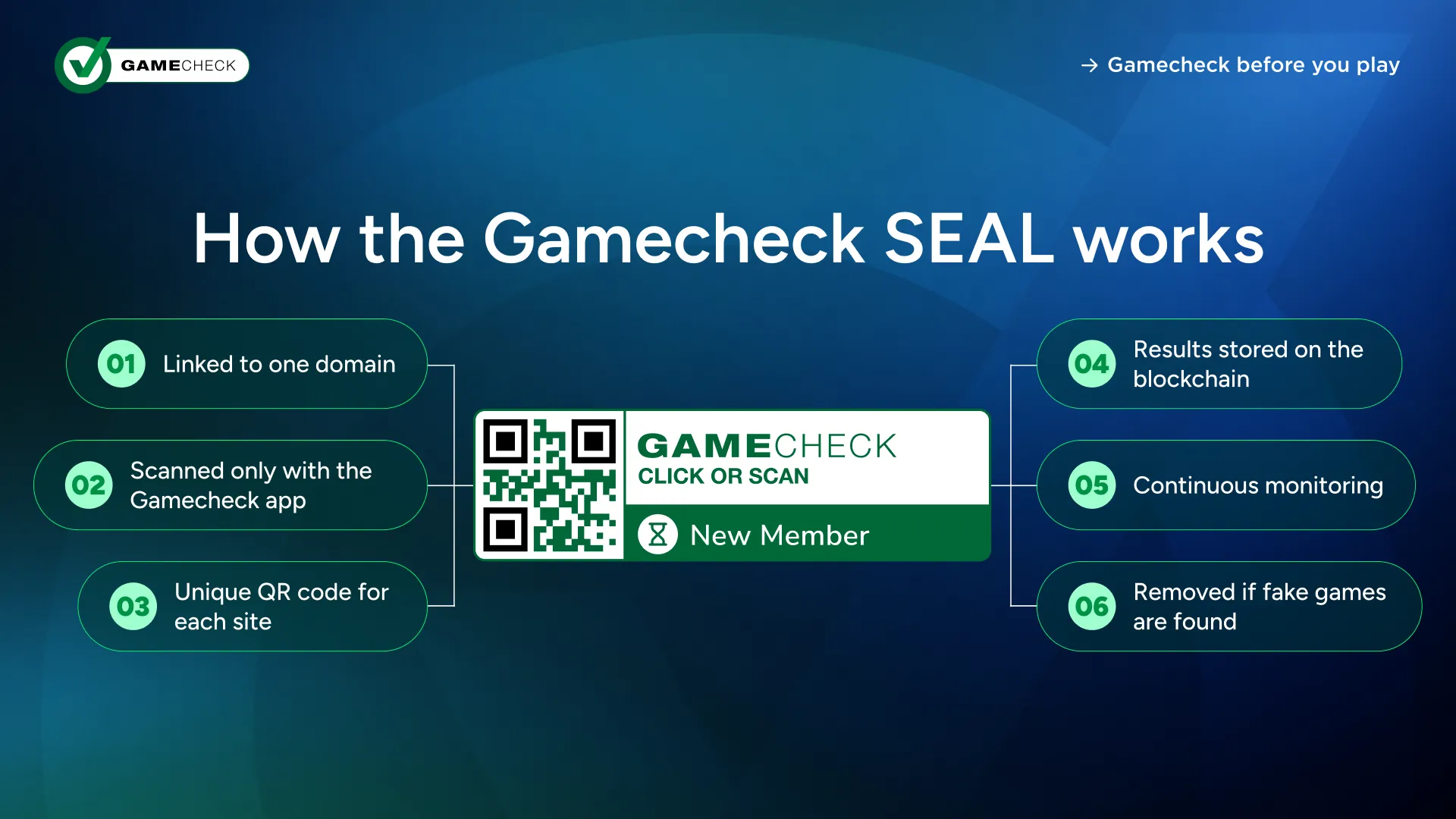
The Gamecheck SEAL is displayed on an operator's site once a selection of games has been verified as real by the original game providers. A few things set it apart from an ordinary badge:
Taken together, these features turn the Gamecheck SEAL into a live signal. The domain link means it belongs to one site. The unique QR code means it can be told apart from every other Gamecheck SEAL. The blockchain record means the result behind it is stored in a way that cannot easily be changed after the fact. The flagging means a copy is caught at the moment a player checks it, and the continuous monitoring means the signal can be withdrawn if something changes.
A copied image can be pasted onto any page, but a copied image cannot carry a working link back to the record behind it. Because each Gamecheck SEAL is tied to a specific domain and its QR code points to a result stored on the blockchain, scanning it is a way of checking the badge against where it is actually being shown, rather than simply trusting that it looks right.
That is also why copying the Gamecheck SEAL does not work. When a player scans a Gamecheck SEAL that has been lifted from its original domain and placed somewhere else, the Gamecheck app does not return a pass. It flags the Gamecheck SEAL as copied. The copy may look identical on the page, but the moment it is scanned, the mismatch between the badge and the site displaying it comes to the surface.
This is the same gap raised in this blog’s earlier piece on copied branding: a badge that looks convincing is a weak signal, while one that can be checked against a record is a stronger one.
None of this depends on a player being able to spot a fake image by eye, which is useful, since a well-made copy can look identical to the real thing. The point of scanning is to stop relying on how convincing a badge looks and start checking what sits behind it instead.
A picture of a seal is just a picture. A seal that can be checked is something else entirely.
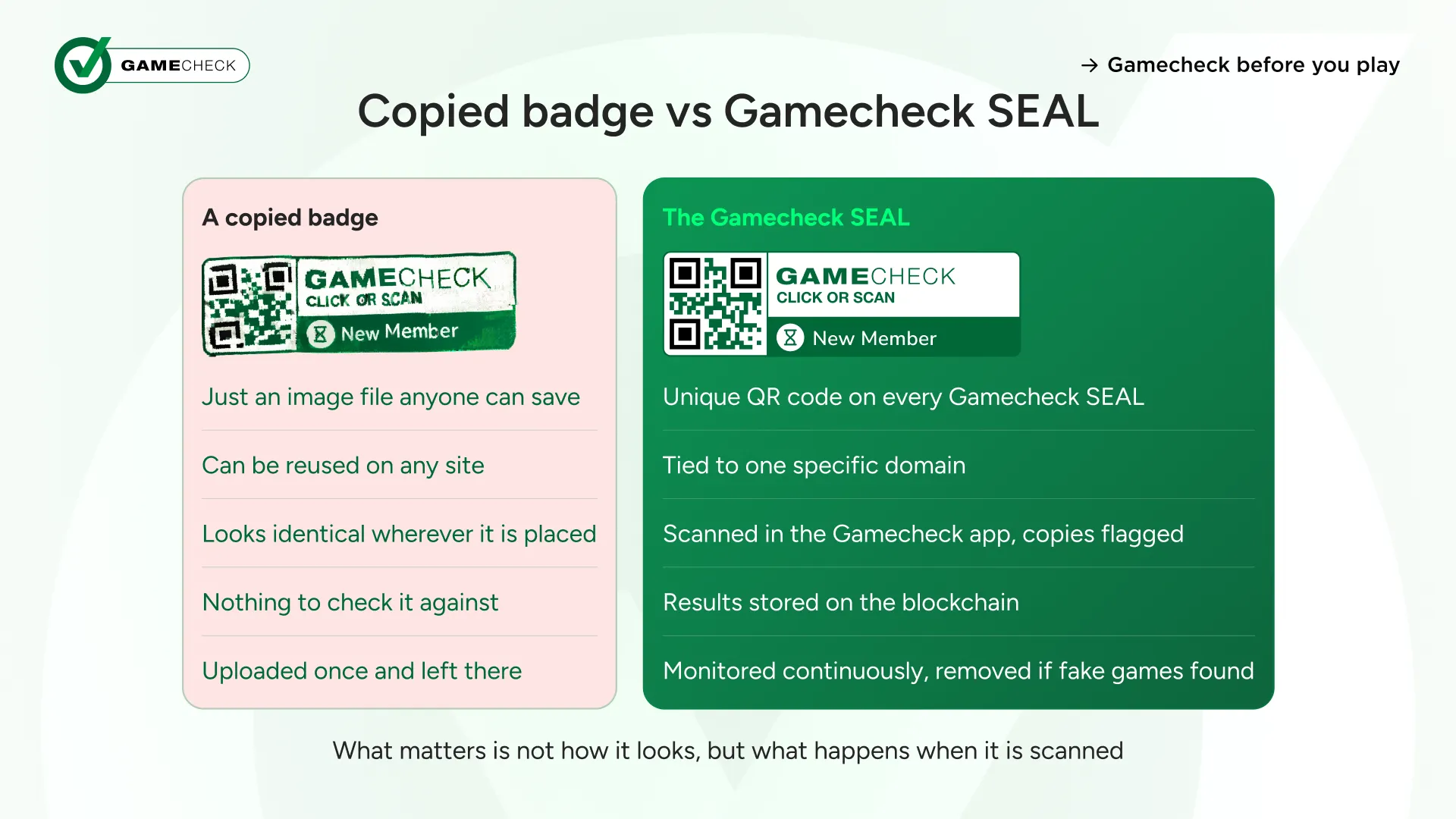
Checking a Gamecheck SEAL does not require any special knowledge. The Gamecheck app reads the unique QR code contained in the Gamecheck SEAL and returns a result based on the record stored on the blockchain for that domain. If the Gamecheck SEAL has been copied onto a site it does not belong to, the Gamecheck app flags it, so the player knows that the badge on the page is not what it appears to be.
The useful habit is simply doing this before trusting the page, rather than assuming the badge is real because it is in the usual place and looks the part. Since a growing share of online casino gaming now happens on a phone, this is a check most players are already set up to do in a few seconds.
A Gamecheck SEAL that was only ever checked once, at the moment it was first issued, would still leave a gap. This blog's earlier piece on Gamecheck's conversation with the iGaming AFRIKA podcast covered exactly this problem: an operator can pass an early check and still swap in a fake game later, once attention has moved on.
The Gamecheck SEAL is built around the same principle. Operators displaying it are monitored continuously rather than being checked once. If even one fake game is detected after the Gamecheck SEAL has been issued, the SEAL is removed immediately, and the operator cannot reapply until 12 months have passed.
This is also why scanning matters more than memory.
A player who saw a Gamecheck SEAL on a site last month, and simply remembers seeing it, is relying on something that may no longer be current. Scanning checks the record as it stands now, rather than as it stood whenever the player happened to notice the badge in the first place.
An online casino that does not display a Gamecheck SEAL has not necessarily done anything wrong, and Gamecheck does not judge any operator on that basis. The Gamecheck SEAL is a way for operators that have had a selection of games verified as real by the original game providers to show it in a form players can check. Its absence means you cannot be certain the games on offer are real.
For operators, displaying the Gamecheck SEAL is a way of showing that a selection of games has been checked. Within the iGaming industry, that distinction matters: a claim on a website costs nothing to make, while a Gamecheck SEAL tied to continuous monitoring carries an ongoing commitment to keep it. An operator choosing to display the Gamecheck SEAL is also choosing to be checked on an ongoing basis, not just at the point the Gamecheck SEAL first goes up, which is a different kind of commitment from the usual badge that is simply uploaded once and left there.
The flagging of copied Gamecheck SEALs protects operators too. An operator who has earned the Gamecheck SEAL does not have to watch the same badge appear on unrelated sites and lend them credibility, because any player who scans the copy will see it flagged.
For game providers, the same process that supports the Gamecheck SEAL is also what helps identify copied or fake versions of their games circulating elsewhere, since checking a game as real is the other side of being able to say that a different version is not. A provider whose games are frequently copied has a direct interest in operators choosing to display something that can actually be checked, rather than a badge that asks to be taken on trust.
A badge is only as useful as what happens when someone checks it. The Gamecheck SEAL is designed so that copying the image is not enough to copy what it actually represents, since the domain link, the unique QR code, and the record stored on the blockchain all travel with the real thing and not with a screenshot of it. Anyone who scans a copied Gamecheck SEAL will find it flagged by the Gamecheck app. Gamecheck is an independent provider of tools, research, and education that helps online casino players determine whether online casinos offer real casino games.
Published On: Nov 03, 2026
Updated On: Nov 04, 2026
Can an online casino copy the Gamecheck SEAL from another site?
An online casino can copy the image, but not what sits behind it. Each Gamecheck SEAL is connected to a specific domain and contains a unique QR code linked to a record stored on the blockchain. When a player scans a copied Gamecheck SEAL with the Gamecheck app, it is flagged as copied, and copied Gamecheck SEALs are blocked.
What happens if fake games are found on an online casino that holds the Gamecheck SEAL?
Operators displaying the Gamecheck SEAL are monitored continuously. If even one fake game is detected, the Gamecheck SEAL is removed immediately, and the operator cannot reapply until 12 months have passed.
Does the Gamecheck SEAL mean every game on an online casino is real?
No. The Gamecheck SEAL shows that a selection of games has been verified as real by the original game providers, not every title an operator offers. To check an online casino’s current status, players can use the Gamecheck Search Tool, which shows whether real games are in operation, fake games have been detected, or checks are pending.
Join operators using Gamecheck SEAL to protect players and grow credibility.