Fake online casinos are not random operations thrown together overnight. They are structured businesses with deliberate systems at every layer, from the homepage design to the games themselves. The scale of the problem is growing, and the operations behind these sites are becoming increasingly sophisticated.
In this article, we take a deeper look inside how a fake online casino actually operates, what players experience, and why the gap between appearance and reality is so difficult to see from the outside. Gamecheck investigates and exposes fake online casinos. You can search any online casino in the database.
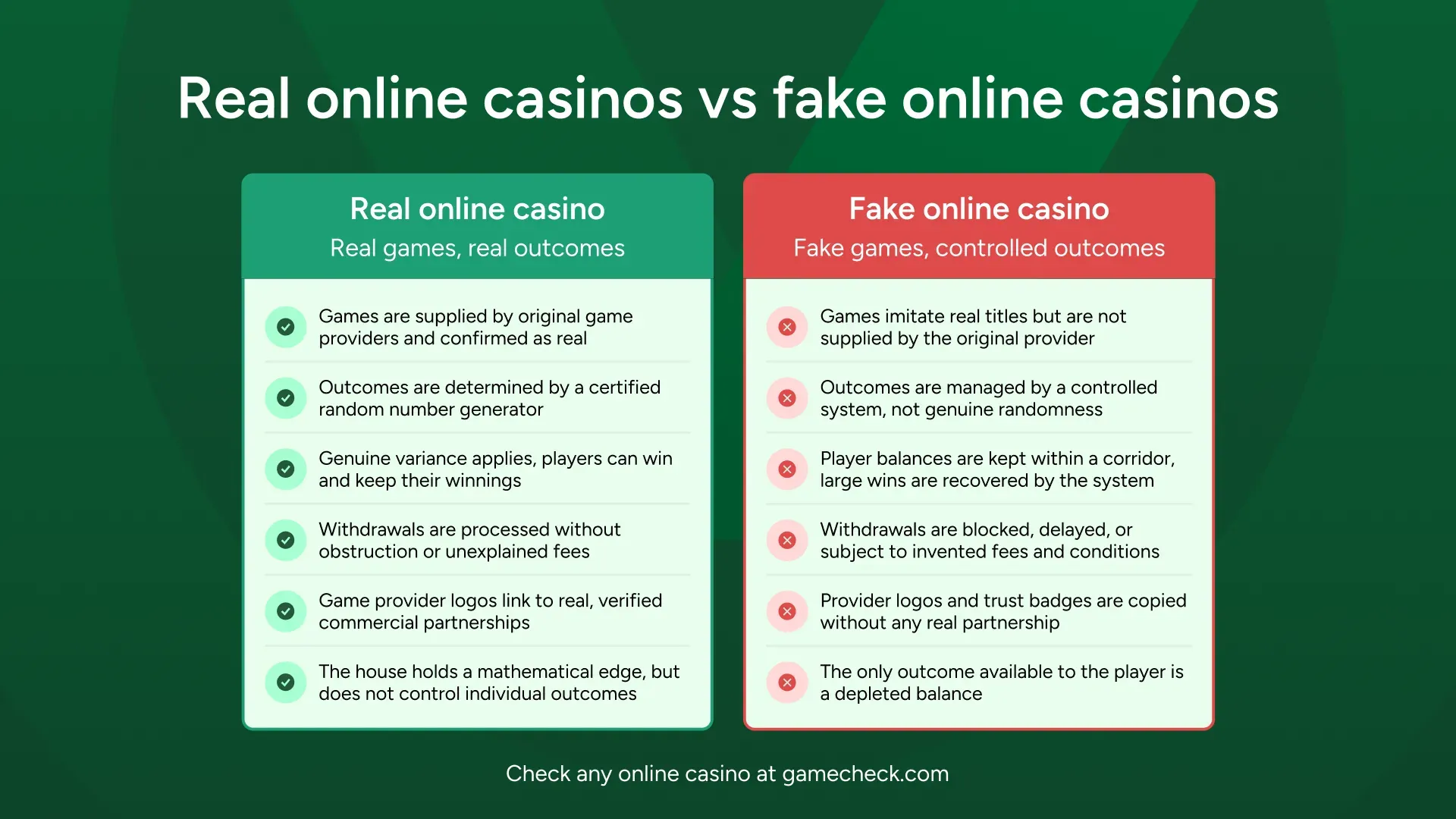
The first thing a fake online casino invests in is appearance. The homepage is designed to mirror the look of well-established operators - professional graphics, familiar layouts, and a row of game provider logos displayed prominently. Those logos are typically copied without any agreement with the original providers. They are there to create an impression of credibility.
The games follow the same logic. They load quickly, the interfaces are polished, and the sound design is convincing. At a glance, the experience feels indistinguishable from a real online casino. That is entirely by design. Rogue operators are not cutting corners on presentation, they are investing in it, because the front of house is what keeps players from asking questions.
Real game providers have confirmed to Gamecheck on multiple occasions that games found on certain sites are not their products. The branding is copied. The gameplay works differently.
Fake online casinos also invest heavily in marketing. Large bonus offers, influencer promotions, sponsored content, and social media giveaways are all standard tools. The purpose is the same as the homepage design to build enough surface credibility that players deposit before they look more closely. By the time problems surface, the operator already has the money.
This is where the operation becomes most significant for players.
In a real game, outcomes are determined by a certified random number generator, an independently tested system that neither the player nor the operator can influence. Genuine variance applies. Players can win. They can lose. Neither outcome is predetermined, and in rare cases a player can walk away significantly ahead. The house holds a mathematical edge over time, but individual outcomes remain genuinely unpredictable.
In a fake game, that system is replaced entirely. What sits underneath the familiar interface is a different set of instructions, ones designed to keep each player account moving within a controlled range. The mechanics work like this: a player begins winning, confidence grows, bets may increase. The system produces a corrective sequence - a run of losses that pulls the balance back toward a predetermined corridor. The player experiences what feels like a natural swing of luck. The swing is not natural. It is managed.
Think of it as a pendulum. The balance moves up, then the system pulls it back. Up again, then back further. The player is never allowed to drift too far into profit. The movement creates the sensation of a real game - there are wins, there are losses, there is the feeling of variance, but the corridor itself is fixed. The casino controls the swing. Probability does not.
A significant win, a larger bet size, a withdrawal request, or a bonus being activated are all triggers that cause the system to tighten its grip on the player's balance. The algorithm adjusts in real time to protect the house's position whenever a player begins to pull ahead. Players may not identify the trigger, but many recognise the feeling: a promising run that stalls just as it builds momentum, followed by a sequence of losses that erases the gain.
In a real game, the possibility of a large win is genuine, a player can walk away significantly ahead, and the house accepts that. In a fake game, large wins do occur, but they function as bait rather than real outcomes. They keep the player engaged, increase confidence, and encourage larger bets long enough for the system to recover the pay-out and more through the play that follows.
When players notice these patterns and raise concerns, rogue operators consistently attribute it to variance. That framing is deliberate. Variance is a real feature of online casino gaming, and it provides operators with cover to dismiss player concerns as a misunderstanding of how games work. The distinction is straightforward: genuine variance produces genuine winners over time. A controlled system does not. On a fake platform, no consistent winners exist by design.
Fake games are one layer of how rogue operators work. Withdrawal mechanics are another.
A player who manages to accumulate winnings on a fake site will typically find that retrieving them is where the suspicious operation reveals itself. The most common approach is delay - repeated requests for identity documents that were already submitted, new verification steps that appear each time a withdrawal is requested, and customer support responses that never resolve the request. The process is designed to exhaust the player into abandoning the withdrawal or spending the balance on further play.
More sophisticated operations use terms and conditions as the mechanism. A welcome bonus might carry wagering requirements carefully structured to make it mathematically impossible to reach the withdrawal threshold. The player deposits, claims the bonus, plays through what feels like a reasonable number of rounds, and finds that the terms still count them as ineligible to withdraw.
Most of these sites are built to accept deposits and never pay out. They collect funds quickly and shut down or rebrand before the volume of complaints attracts attention. These sites use copied trust badges, and borrowed branding to establish enough credibility to take the first deposit and move on.
The scale of fake casino operations varies considerably, but the underlying structure is consistent. Rogue operators typically route their businesses through multiple jurisdictions, using layered corporate entities to put distance between the front-facing website and the people running it. Funds are then moved through shell companies, intermediary accounts, and cryptocurrency exchanges specifically designed to make financial tracing across borders difficult.
This structure is not accidental. It is designed to make investigation difficult and to ensure that by the time a problem is identified, the responsible parties are several steps removed from the evidence.
The scale of fake online casino networks operating across Europe has prompted Eurojust (the EU Agency for Criminal Justice Cooperation) to run investigations into linked fraud networks. One series of coordinated actions, known operationally as The Project, targets transnational networks running fraudulent gambling platforms across multiple EU countries simultaneously. These are not isolated rogue operators. They are connected networks sharing infrastructure, tactics, and in some cases the same call centre operations.
A network operating fake gambling platforms across Cyprus, Bulgaria, and Serbia was dismantled in 2024, resulting in 15 arrests and estimated damages exceeding €100 million, and a coordinated takedown of call centres in Albania and Georgia running gambling and investment fraud.
A separate Eurojust-coordinated case concluded in October 2025 found that two individuals running several fake online casino websites had generated nearly €1 billion in turnover over five years, with more than €100 million in fund transfers identified between 2022 and 2025.
Not all fake online casino operations require large networks.
In April 2024, Dutch financial crime investigators arrested a 26-year-old man at his home in the Netherlands in connection with a fraudulent online gambling platform that had taken more than $30 million from players worldwide. Searches of the suspect's property uncovered assets worth €11.4 million, including cryptocurrency, real estate, and luxury vehicles. The case illustrates that fake online casino operations are not exclusively the work of large criminal organisations - individuals operating from home can reach tens of thousands of victims across multiple countries.
The practical challenge for players is that fake online casinos are specifically built to pass a quick visual inspection. The site looks professional. The games load. The promotions appear comparable to those on other platforms. There is no reliable way to assess game integrity from the interface alone, because the interface is the part that rogue operators have invested most heavily in replicating.
The gap between what a game looks like and what it actually does is the central problem. A player has no way of knowing, from the visual experience of playing alone, whether the outcomes are being generated by a certified system or a controlled one. The spin looks the same either way. The loss looks the same. The difference is only visible at the level of the underlying code, and that is not something a player can access.
There are more than 150,000 online casino domains worldwide. Gamecheck is currently monitoring 50,000 URLs across its database, of which 5,000 sites have been found to use fake games. That means one in ten sites monitored by Gamecheck has been identified as carrying fake games. These are not rare outliers. They are a consistent feature of the current online casino landscape.
A convincing homepage is not evidence of fair play. Fake online casinos are built precisely to look real, and the gap between appearance and reality is where players lose money. The system underneath a fake game is designed to ensure that no player wins consistently over time. Players cannot identify this from the playing experience alone. What they can do is check whether the games on a site are real before they play.
Before playing at any online casino, check it on Gamecheck first. The Search Tool, Gamecheck app, and Chrome Extension, are all free to use. If a platform is found to carry fake games, players should avoid it entirely. Checking for real games before depositing is the most effective protection available.
Yes. Rogue operators invest heavily in presentation. The homepage design, game interfaces, and promotional materials are built to mirror well-established online casinos. Game provider logos are copied without any agreement with the original providers. The visual experience is indistinguishable from a real online casino by design, because a convincing front is what keeps players from looking more closely before they deposit.
In a real game, outcomes are determined by a certified random number generator that neither the player nor the operator can influence. In a fake game, that system is replaced. The underlying code keeps each player's balance moving within a controlled range. Wins occur, but they function as bait. Whenever a player builds momentum, the system produces a corrective sequence to pull the balance back.
Rogue operators use several methods to prevent withdrawals. The most common is delay, repeated requests for documents already submitted, new verification steps that appear each time a withdrawal is attempted, and customer support that responds without resolving anything. Some operations use terms and conditions to create withdrawal thresholds that are unreachable. The process is designed to exhaust players into abandoning the withdrawal or spending the balance on further play.
Not always. Some are networks sharing infrastructure across multiple countries. Eurojust has run investigations including cases resulting in estimated damages exceeding €100 million. Others are run by individuals. In April 2024, a 26-year-old man operating from his home in the Netherlands was arrested in connection with a fraudulent platform that had taken more than $30 million from players worldwide.
Players cannot determine game integrity from the playing experience alone. The interface of a fake game looks and behaves like the real thing. The difference is only visible at the level of the underlying code. Gamecheck tests games and checks findings with the original game providers to determine whether the games on a site are real. The Search Tool, Gamecheck app, and Chrome Extension, are all free to use. Checking an online casino before depositing is the most practical step any player can take.