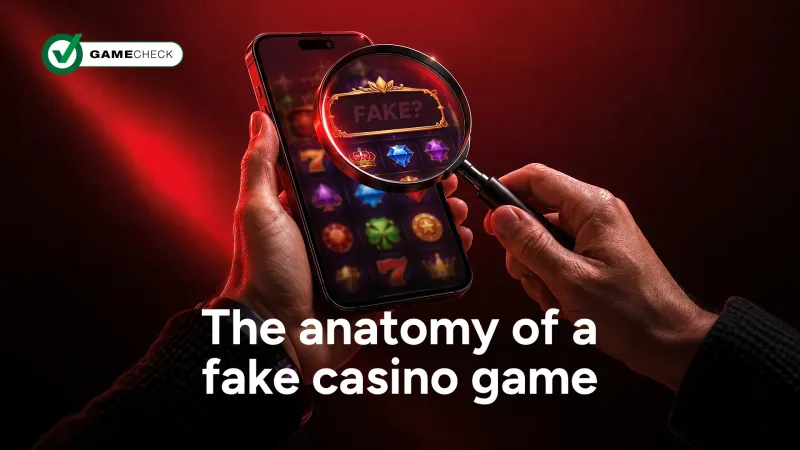
A player sees an ad on social media. The platform looks professional - strong branding, a generous welcome bonus, a familiar game library. They register, make a deposit, and start playing. The games look right but the wins are not coming in the way they should. Withdrawals are delayed, then declined. Customer support does not respond. By the time it becomes clear that the games on offer were not real, the deposit is gone.
Fake games are becoming one of the online gaming industry's fastest-growing threats, raising serious concerns around player safety, trust, and transparency. This article explains how fake games infiltrate online casinos, why legal enforcement alone is failing to contain the problem, and how Gamecheck is helping players identify real operators through verification technology. It also explores why player awareness is becoming the strongest defence against fake gaming content.
Fake games are not random. They follow patterns, and those patterns are measurable. Gamecheck's database currently monitors over 50,000 online casino URLs. Of those, 10% have been found to operate fake games - one in ten platforms assessed is not offering real games to players. Global online gambling revenue was estimated at €72 billion in 2024, and that scale makes the problem worth understanding. The larger the market, the more attractive the opportunity for operators not playing fair. Knowing what a fake game looks like is now a necessity for players.
For years, the primary response to fake casino games was legal action - identifying operators using copied game software and pursuing intellectual property claims. That approach exposed a fundamental problem. Operators hosting fake games are often difficult to trace. Many close under one company name and reopen under another. Legal processes are slow and expensive. By the time enforcement action concludes, the operator has frequently moved on.
The result is a cycle that does not reach the root of the problem. What the industry needs is a parallel approach - one focused on transparency and player-level access to information, rather than pursuing individual operators through legal channels alone.
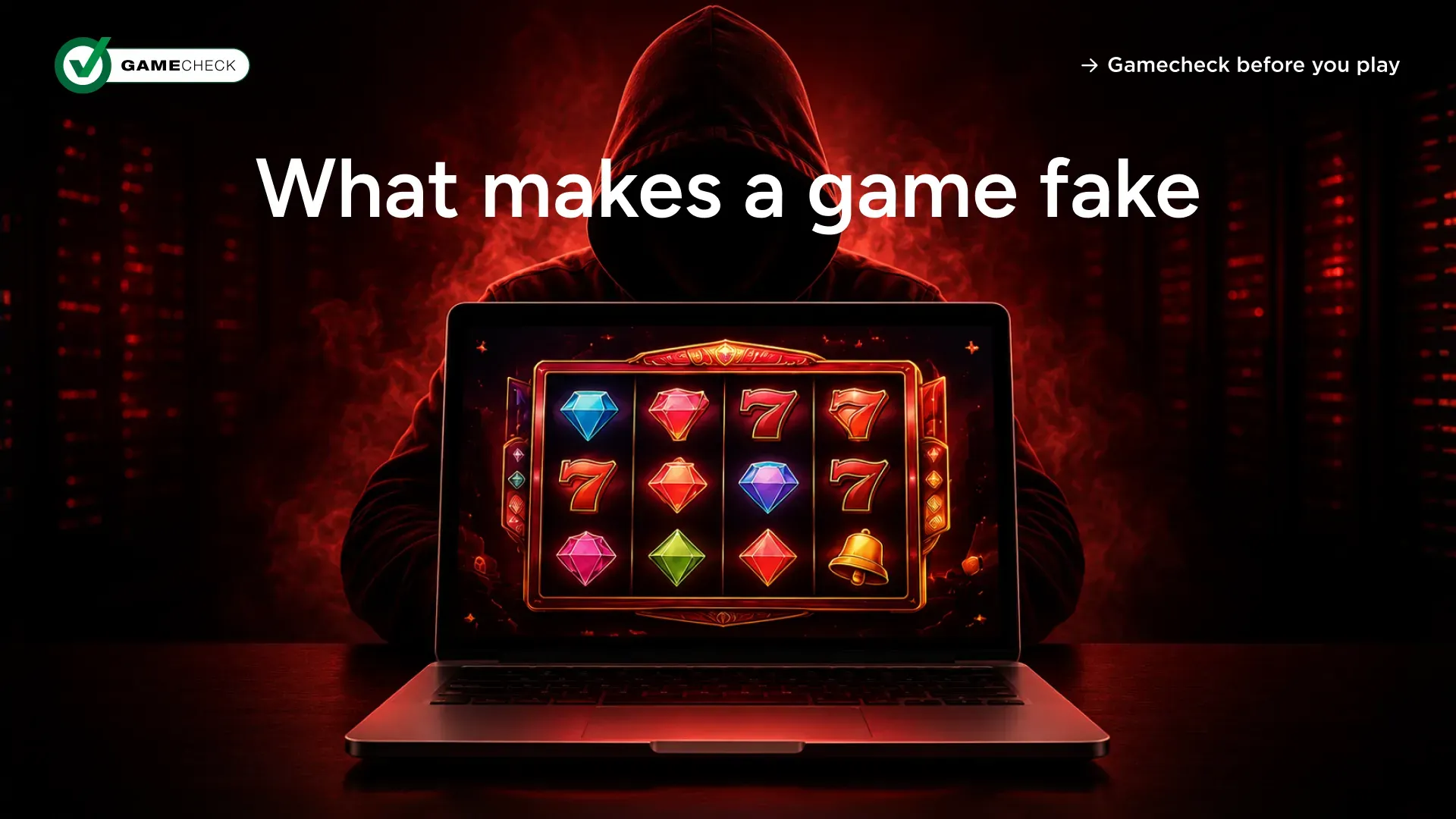
A real game is supplied directly by the original game provider and runs through authorised distribution infrastructure. The software, graphics, code, and server environment are all controlled by the provider. A fake game may look identical on the surface - the name, layout, and animations can all be replicated. But behind the interface, the software has been copied or modified, and the hosting environment is unknown.
This distinction matters because it affects outcomes. A real game operates according to published return-to-player (RTP) figures set by the game provider. RTP is the percentage of all wagered money a game returns to players over time. When that software is copied, the displayed RTP figure becomes meaningless. The house edge is no longer a calibrated margin - it becomes whatever the operator chooses. Outcomes can be modified. Win rates are suppressed. The experience a player receives may bear no relation to the real game they believe they are playing. A slot that should return 96% might return considerably less. A blackjack game that should carry a 0.5% house edge might be running at multiples of that figure.
Unlike fake goods where quality difference is often visible or tangible - fake online casino games are almost impossible to distinguish. The graphics, animations, and interface can all be replicated with reasonable accuracy. The manipulation is in the code, not the presentation. This is why surface-level assessment is not enough. Identifying a fake game requires checking the gameplay - not how it looks on screen.
Understanding what a fake game looks like is one part of the picture. Understanding how players are directed towards them is another. Fake online casino games do not exist in isolation - they are the end point of a deliberate distribution chain, and social media advertising has become one of its primary entry routes.
Research by cybersecurity firm Group-IB identified over 500 deceptive advertisements and 1,377 malicious websites designed to funnel users towards fraudulent gambling applications. These are not low-effort operations. The ads are professionally produced, localised into multiple languages using AI-generated voices, and targeted at specific regions - including Europe, the Gulf, Egypt, and Asia. The mechanics are consistent across markets. The presentation changes to appear local and credible. The outcome for the player does not.
The approach typically follows a recognisable pattern. A social media ad promises fast returns from a betting game. Users are directed to download an application - often distributed outside official app stores via third-party websites, bypassing security checks entirely. Once installed, the app collects personal and financial data during the registration process. Players who deposit funds frequently cannot withdraw them.
Fake reviews and fabricated testimonials are used throughout to maintain the appearance of credibility. These are not brief five-star ratings. They include detailed narratives, screenshots of purported winnings, and video content featuring actors posing as satisfied players. The effect is to create the impression of a functioning, profitable platform before a player has made a single deposit.
The connection to fake games is direct. Many of these fraudulent apps and websites do not simply steal registration data - they also host copied casino games. Players encounter games that may look familiar but are not supplied by the original game providers. The software has been replicated, the outcomes may be altered, and the displayed RTP figures carry no relation to how the game actually performs.
This is where the Gamecheck Search Tool provides a practical first check. Before registering on an unfamiliar platform, players can run the domain through Gamecheck.com. Platforms where fake games have been detected return a red status. The check takes around 30 seconds and does not require an account.
The scale of the social media advertising problem also reinforces why verification tools matter at the point of discovery, not after a deposit has been made. By the time a player notices that withdrawals are being blocked, the process of recovering funds is already significantly harder.
These patterns appear consistently across fake online casino games.
Visual quality. Real games are developed by original game providers with significant production budgets. Graphics are sharp, animations are fluid, and the interface scales cleanly across desktop and mobile. Fake games frequently display pixelation, inconsistent resolution, or elements that appear misaligned or compressed. These are not design choices - they are the result of copied or poorly reconstructed software. A game that looks noticeably degraded compared to titles from the same provider on other platforms is worth investigating.
Provider branding. Every real game carries the original provider's logo. That logo is not decorative - it represents the chain of distribution from provider to operator. If a game displays no provider branding at all, or carries a name that does not correspond to an established provider with a verifiable presence outside that platform, the underlying software is unlikely to be real. Some fake platforms use invented provider names to simulate credibility.
Bonus structure. The online casino industry operates within consistent commercial parameters. Welcome bonuses and free spins follow recognisable patterns set by operators working within real business models. When bonus offers appear significantly above market norms - at levels no sustainable commercial model could support - that gap is informative. Fake operators frequently use inflated bonus offers to attract sign-ups quickly, before players have the opportunity to assess the quality of the games on offer.
Customer support. Real operators invest in support infrastructure because players require help with deposits, withdrawals, and account management. That infrastructure has a measurable cost, and real operators carry it because long-term player relationships depend on it. Across the fake online casino profiles tracked in Gamecheck's database, absent support is a consistent feature - unanswered live chat, no response to email enquiries, and generic replies when any contact is made at all. A platform with no real support capability is a platform that does not anticipate long-term player relationships.
Outcome patterns. Real games operate according to RTP figures that are fixed within the original game provider's software. Those figures exist within a structure designed to keep the game commercially viable over thousands of plays, not to produce consistent, accelerated losses within short sessions. When a player experiences recurrent losses that fall well outside expected statistical norms for a given game type - particularly across multiple sessions on the same platform - the underlying software may have been altered. The displayed RTP figure means nothing if the code behind it has been modified.
Not every signal points toward a problem. The Gamecheck SEAL is one of the clearest indicators that an online casino is operating with real games.
The Gamecheck SEAL is awarded to operators whose games have been tested and findings checked with the original game providers to determine whether they are real. It is displayed in the footer of the operator's site, connected to a specific domain, and logged on the blockchain. Operators displaying the Gamecheck SEAL are subject to continuous monitoring. If fake games are subsequently detected, the Gamecheck SEAL is removed immediately and reapplication is blocked for 12 months. Its presence is a meaningful positive signal - it represents a process that fake operators cannot replicate.
A copied Gamecheck SEAL. Some rogue operators go further, replicating the Gamecheck SEAL in an attempt to appear checked. This is where the Gamecheck app provides a direct and immediate answer. Every real Gamecheck SEAL contains a unique QR code linked to a specific domain logged on the blockchain. Scanning the Gamecheck SEAL using the free app on iOS and Android returns real-time status data tied to that domain. A copied Gamecheck SEAL will be blocked and flagged simultaneously. Players should scan any Gamecheck SEAL they encounter with the Gamecheck app before depositing money.
Fake game distribution does not operate in isolation. When a platform is found to host copied games from one provider, it typically hosts copied games from several others. This pattern makes shared intelligence across the industry far more effective than individual enforcement.
Gamecheck works directly with game providers to cross-reference findings. When providers share database intelligence, patterns across the fake gaming ecosystem become clearer and suspicious operators can be identified more efficiently. The collaborative model allows findings to be checked with multiple providers simultaneously, producing a more complete picture of how fake games are distributed and where clusters of fake content are concentrated.
The industry has made meaningful progress on safer gambling and financial crime prevention. Game integrity is the area where attention is still catching up with the scale of the problem.
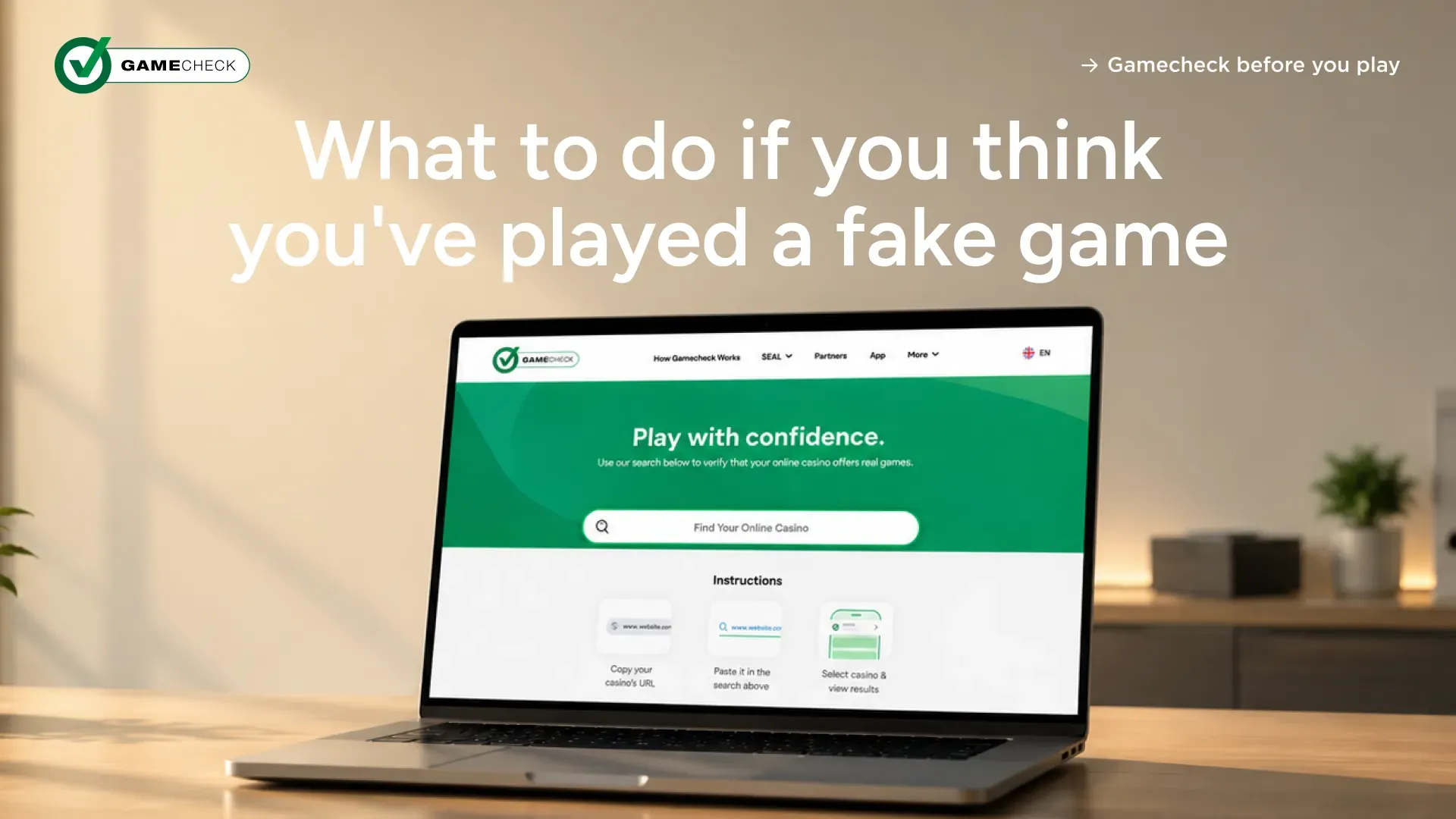
If something about an online casino feels wrong - outcomes that do not follow expected patterns, withdrawals that cannot be processed, support that does not respond - the first step is to run the domain through the Gamecheck Search Tool.
The check takes around 30 seconds and returns one of three results: real games in operation, fake games detected, or pending checks. If the platform returns a red status, fake games have been identified on that domain. For real-time checks while browsing, the Chrome Extension retrieves live data from the database without leaving the browser.
The second step is to submit a report. Players can flag any online casino platform including those not yet in the Gamecheck database at Request Casino Verification | Gamecheck.
Once a report is submitted, Gamecheck begins its research process. The platform is assessed, findings are checked with the original game providers, and the result is added to the database. That information then becomes available to every other player who runs the same domain through the Gamecheck Search Tool.
Each verified fake platform added to the database makes it harder for that operator to reach new players undetected. Continuous monitoring means that if a flagged domain attempts to reactivate, it remains tracked. The database grows with every report submitted.
Fake games share a consistent profile. Visual degradation, missing or invented provider branding, implausible bonus structures, absent support, altered outcomes, and the absence of credible third-party checks - these signals are individually informative and collectively reliable.
Consumer awareness is the best defence available. Legal enforcement addresses individual operators. Verification tools address the problem at the point where it affects players most directly - before they deposit, before they play, and before the damage is done.
Check any online casino at gamecheck.com before you play.
A real casino game is supplied directly by the original game provider and runs through authorised distribution infrastructure. The software, code, and server environment are all controlled by that provider. A fake game may look identical on the surface, but behind the interface the software has been copied or modified, and the hosting environment is unknown. The displayed return-to-player figure becomes meaningless. The house edge is no longer a commercially calibrated margin, but however the operator chooses to set it.
Fake casino games are the end point of a deliberate distribution chain. Social media advertising is one of its primary entry routes. Professionally produced ads, often localised using AI-generated voices, direct users to download applications outside official app stores via third-party websites, bypassing security checks entirely. Fake reviews, fabricated testimonials, and video content featuring actors posing as satisfied players are used to create the impression of a credible platform.
The graphics, sound design, and interface of a fake game can all be replicated with reasonable accuracy. The manipulation is in the code, not the presentation. A player has no way of determining from the visual experience whether outcomes are being generated by the original provider's software or a modified version of it. Surface-level assessment is not enough. Identifying a fake game requires checking where it comes from and how it is being delivered.
Across the platforms tracked in Gamecheck's database, several patterns appear consistently. These include visual degradation compared to the same game on other platforms, missing or invented provider branding, bonus offers significantly above market norms, absent customer support, and outcome patterns that fall outside expected statistical ranges for the game type. No single signal is definitive on its own. Together, they form a reliable profile.
The Gamecheck SEAL is awarded to operators whose games have been tested and findings checked with the original game providers. It is connected to a specific domain, logged on the blockchain, and subject to continuous monitoring. Some rogue operators attempt to copy the Gamecheck SEAL to appear verified. Scanning the Gamecheck SEAL using the free Gamecheck app returns real-time status data tied to that specific domain. A copied Gamecheck SEAL will not return a valid result - it is blocked and flagged simultaneously. Players should scan the Gamecheck SEAL before depositing.