
The online casino gambling industry continues to expand across regions, devices and demographics. Growth remains steady. Player traffic remains strong. Fake games have not disappeared in 2026. What has changed is not just how rogue operators behave. It is how the online casino gambling industry monitors them.
Before 2025, checks were largely manual and reactive. Investigations were often triggered by complaints or isolated reviews. There was no structured, continuous system tracking online casino domains at scale.
In 2026, that environment is different. Gamecheck’s monitoring model has shifted the landscape from occasional checks to ongoing, evidence-based monitoring. That structural change is central to understanding what has evolved - and what has not.
In 2026, Gamecheck continues to build upon the solid foundation established in 2025, expanding its efforts to eliminate fake games in the online casino gambling industry.
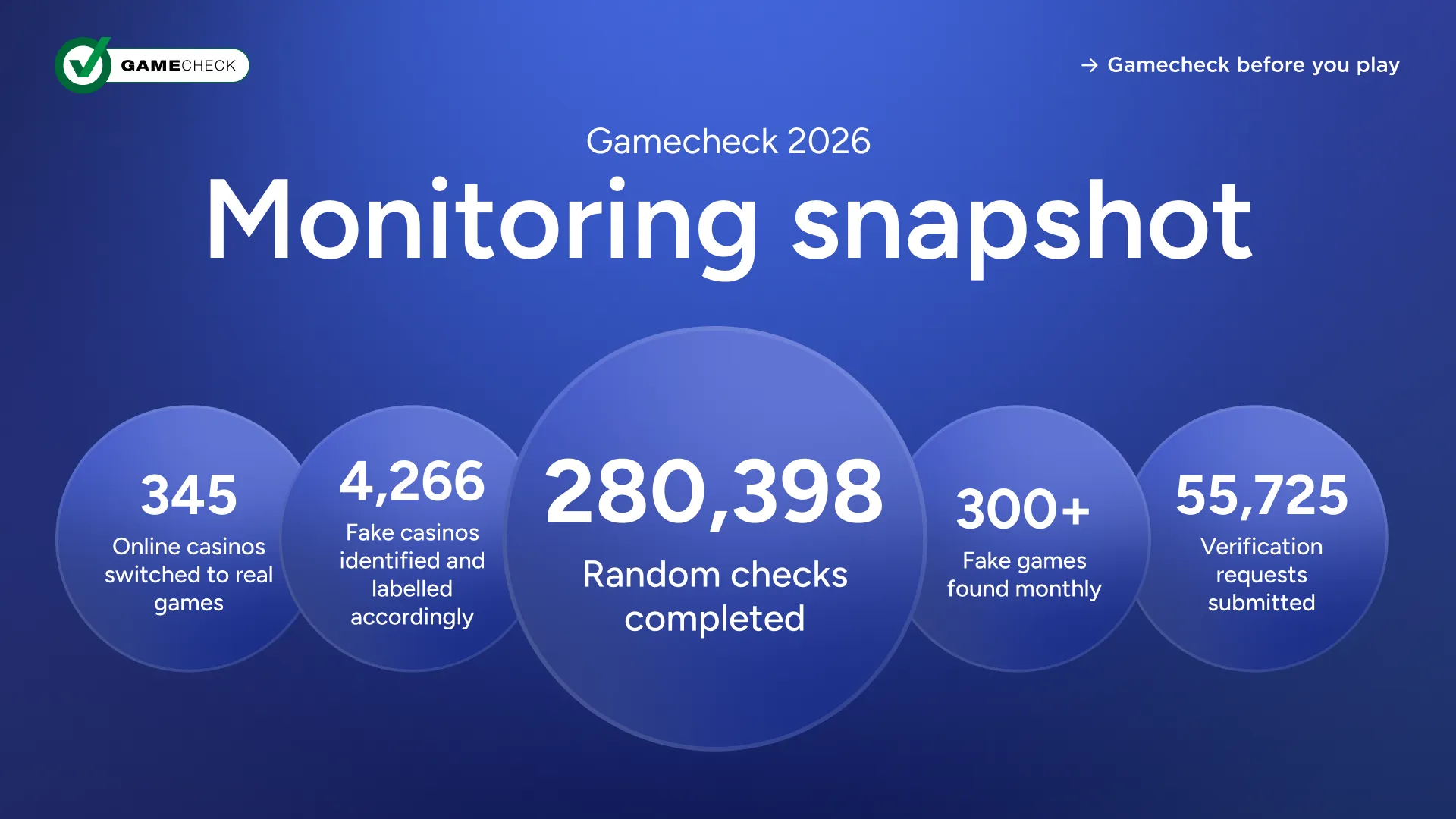
The data from early 2026 marks a further evolution in our fight against fraud:
The key shift in 2026 is no longer about whether fake games exist, it's about how behaviour has adapted under continuous oversight. The focus is now on long-term player protection through regular, real-time monitoring, ensuring that the industry remains transparent and accountable as it grows.
Prior to 2025, checks across the online casino gambling industry were largely manual. A suspicious site might be reviewed. Evidence might be gathered. But there was no persistent tracking system.
Reputable authorities and industry bodies occasionally publish lists of domains associated with irregular activity. Those lists provide useful reference points, but they are typically static, one-off publications.
Ongoing monitoring is different. Gamecheck tracks domains over time. Sites that have been identified remain visible within the database. Randomised checks continue. Status updates reflect new findings when evidence changes.
If fake games are detected, the outcome is publicly labelled. If a site later switches to real games, that behavioural shift is also reflected. Continuous monitoring creates accountability over time rather than a single moment of exposure.
In 2026, monitoring is ongoing. Domains flagged with irregularities are not reviewed once and forgotten. They remain under structured observation. Randomised checks continue. Status updates are public. If fake games are detected after previous clearance, outcomes change. Exposure now has consequences beyond a single report.
One visible shift is domain turnover. Monitoring shows that some fake online casino domains disappear shortly after exposure, only to reappear under new names or slightly altered URLs. Rather than operating under one stable identity, rogue operators increasingly rely on rapid rebranding and mirrored domains. The operational window appears shorter. Domain cycling appears more frequent. However, faster rotation does not eliminate detection. Pattern recognition improves as repetition increases.
Exposure does not always lead to disappearance of the online casino platform operating fake games. Some operators exit the market once exposed. Some rebrand. Some correct.
Over the last year, 345 online casinos switched to real games after fake titles were identified by Gamecheck's investigative team. That reflects something important. Transparency changes incentives. Some rogue operators are correcting their behaviour and removing fake games from their sites. This behavioural response is more visible in 2026 because monitoring is consistent rather than occasional.
The visual quality of fake casinos has improved.
In 2026, many fake platforms present:
At first glance, they can look convincing. Surface presentation is no longer a reliable indicator of fair play. But while visual sophistication has improved, monitoring has evolved as well.
Gamecheck’s back-end checks are not based on design or branding. They are based on testing games and checking findings with the original game providers. Fake games can no longer hide behind improved designs. The evidence still speaks for itself.
Automation tools now enable rapid replication of templates, translation into multiple languages, and generation of credible-looking content. This lowers the cost of imitation. It does not increase the ability of fake games to withstand structured checks. Automation increases volume but it does not increase authenticity.
Traffic patterns show broader cross-border targeting. In 2025, some fake sites concentrated on specific regions. In 2026, multilingual deployment has increased, with simultaneous targeting across multiple markets. From a monitoring perspective, this widens exposure but also creates repeated structural fingerprints across domains. Expansion spreads reach. It does not remove traceability.
Despite improved presentation and domain cycling, some things have not changed.
Fake games still rely on imitation rather than innovation. Copied assets and unauthorised distribution remain central.
Avoidance behaviour remains predictive.
Sites that delay or avoid checks continue to show a higher likelihood of irregularities later.
Continuous monitoring disrupts stability. Traffic often declines after public exposure and status updates.
Player behaviour is evolving. Verification searches, and app usage continue to increase moving into 2026. More players are checking domains before registering or depositing.
That behavioural shift may be one of the most important positive indicators across the online casino gambling industry.
The most significant difference in 2026 is the existence of measurable, ongoing monitoring. Before, fake games were harder to identify and quantify. Now, they are systematically identified, checked with original game providers, publicly labelled, and monitored over time. That shift from manual detection to continuous oversight has altered the risk landscape across the online casino gambling industry. Fake games have not disappeared. But they now operate in a more transparent environment.

Fake games in 2026 may have changed in presentation, speed and scale, but so has the way they are checked and monitored changed and improved significantly. Before registering and depositing and of your funds, check the online casino domain. Use the Gamecheck search tool. If a Gamecheck SEAL appears, verify it in the Gamecheck app.
In a visually sophisticated environment, verification is no longer optional. It is the difference between fake games and fair play. Always Gamecheck before you play.