The online casino market is one of the fastest-growing sectors in digital entertainment. The numbers behind that growth are significant. The data on player behaviour inside that growth is more significant still. Because alongside every metric that shows how many people are playing, there is a parallel dataset tracking how those players are thinking. And in 2026, what players are thinking about is trust.
This article sets out what the numbers reveal about where the industry is heading.
The global online gambling market is valued at $120.35 billion in 2026, projected to reach $211.99 billion by 2031, nearly doubling within a decade. That growth is already reflected in participation numbers. One in five adults globally had gambled online by 2025 - around 882 million people, the majority via smartphone.
Online channels now account for 56% of gambling revenue in the UK alone. Globally, online casino gaming held a 50% share of the total online gambling market in 2025, the largest of any segment, and is forecast to grow at the highest rate of any category through 2031. These are the numbers of a mainstream market.
A market this large and this mobile creates a specific kind of player challenge: there are more platforms than any individual player can assess. The data shows that players have responded to this challenge by becoming significantly more investigative before they play.
According to figures from Casino.org’s 2025 iGaming industry report, there has been a 20% increase in users searching for information about operator withdrawal processes, a 15% increase searching for banking details, and a 12% increase in players investigating process-specific information before committing to a platform. Players are not arriving at an online casino and immediately depositing. They are researching first.
Players now judge an online casino before they judge the games. That is the key finding of the American Casino Guide Book's May 2026 report, "Trust signals in iGaming: how players evaluate casinos in 2026". The decision about whether a platform deserves a deposit precedes the decision about which game to play.
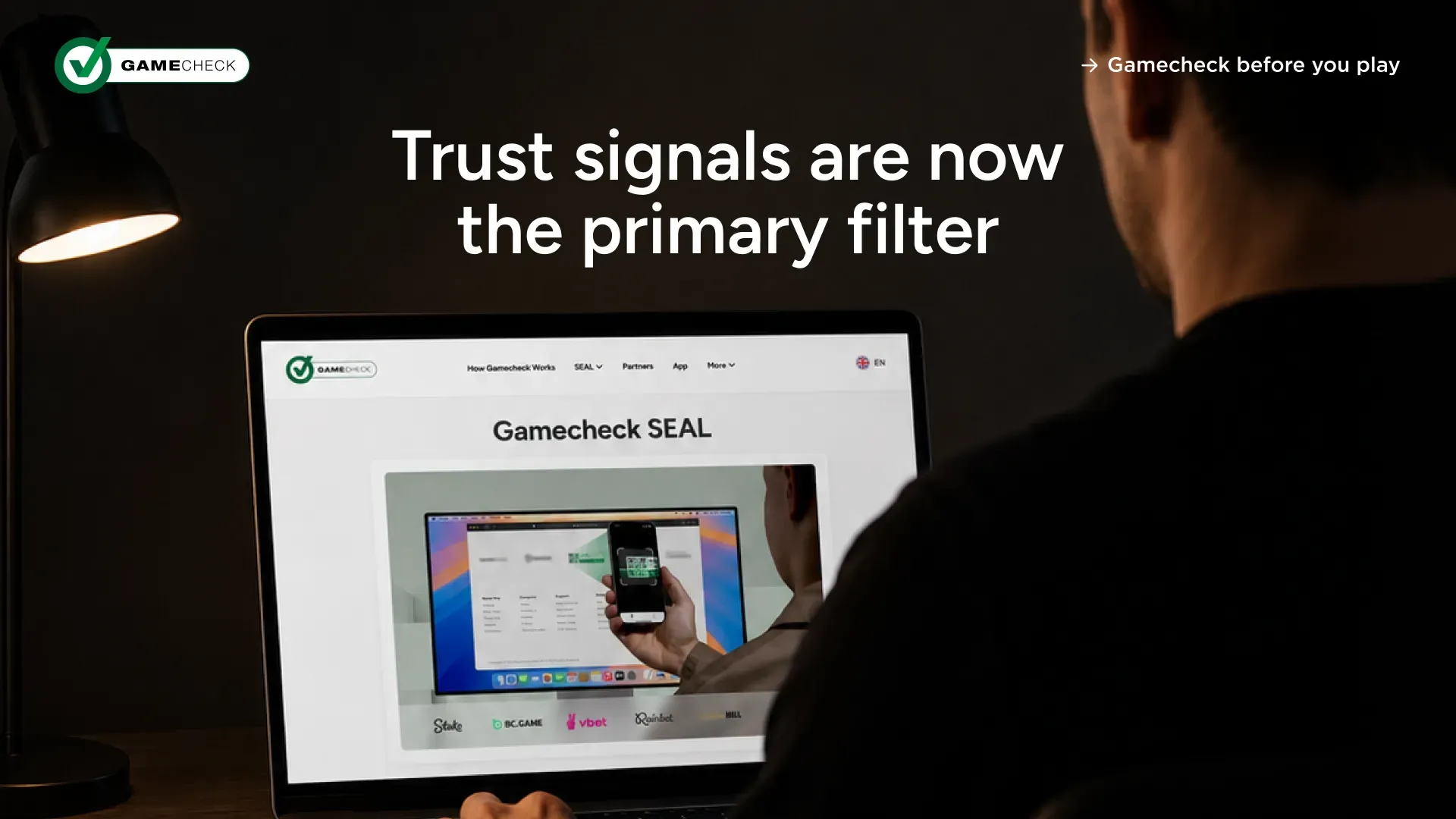
The evidence points clearly to trust signals as the primary factor in player evaluation. Independent reviews and visible indicators of fair play have become more important than bonus offers or game libraries.
This is reflected in game category behaviour. The live dealer segment, where physical visibility of real gameplay is the main product feature, has grown at 24.7% annually, and now represents 53.4% of all online betting activity. Player survey data consistently identifies "more real" as the top reason for choosing live casino over standard digital formats. Players are gravitating toward categories that feel demonstrably fair.
Within this picture of players actively seeking verifiable signals of fairness, the Gamecheck SEAL is establishing itself as one of the most credible trust badges available in the industry.
The Gamecheck SEAL is awarded to operators whose games have been tested and found to be real in collaboration with the original game providers. It is dynamic, connected to a specific domain, and carries a unique QR code that can only be scanned using the Gamecheck app. That means it cannot be copied or faked. Any attempt to display a copied Gamecheck SEAL is identified and blocked simultaneously.
The scale at which the Gamecheck SEAL is now operating reflects growing demand.
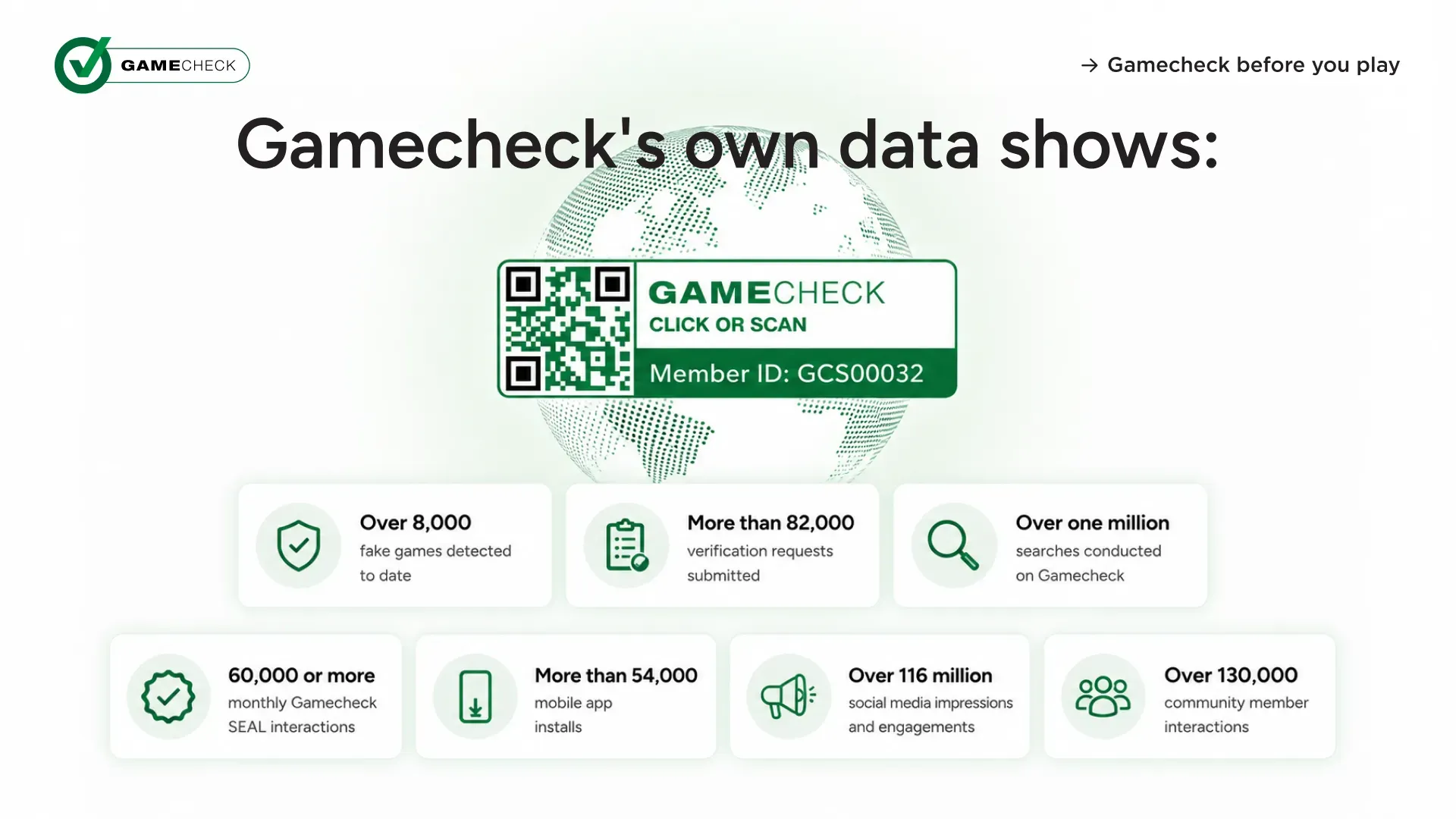
Those numbers represent players and operators actively engaging with a checking process, at scale, on an ongoing basis. The Gamecheck SEAL is not a static certificate. It reflects continuous monitoring - games are checked regularly while a site is live, meaning the status displayed to a player at any given moment reflects the current state of that platform, not a historical one.
For operators, the data case for the Gamecheck SEAL is direct. Visible verification signals reduce player hesitation at the point of conversion. Platforms displaying the Gamecheck SEAL give players the confidence to return, retention built on something more durable than promotional offers.
The Gamecheck SEAL also provides a practical defence against brand impersonation: an operator whose real Gamecheck SEAL can be scanned and checked in real time is significantly harder to imitate than one whose credibility rests solely on appearances.
For players, the value is equally clear. The Gamecheck SEAL answers the question players are already asking before they deposit. It is a visible, scannable indicator that a selection of games on a platform have been checked found to be real, with the further assurance that if fake games are subsequently detected, the Gamecheck SEAL is removed immediately and the breach made publicly visible on the Gamecheck platform.
The Gamecheck SEAL has been recognised at industry level. Gamecheck was named ICE Best Newcomer 2026, was a top three SiGMA finalist for innovative start-ups, and received an iGamingnews awards nomination in 2026. That recognition reflects a broader industry acknowledgement that independent game checking delivered at scale fills a gap that other trust signals do not.
Reported fake casino scam incidents have risen sharply year on year. Tracked cases went from 14 in 2022 to 40 in 2023, 80 in 2024, and 40 more in the first half of 2025 alone. That trajectory reflects both the growth of the market and the increasing number of operators not playing fair within it.
The pattern of complaints reinforces this. A detailed analysis of 690 formal player complaints processed during 2025 found that almost every second complaint came down to withdrawals. Players were asking for money that already belonged to them. The pattern was consistent: platforms functioned without obvious problems right up until the point at which money needed to leave. That is the point at which operations running fake games most commonly reveal themselves.
For players, the problem is rarely visible at the point of first play, it becomes visible at the point of withdrawal, when the money is already gone.
Players aged 18 to 34 now account for the largest segment of the online casino player base, with an 11.98% compound annual growth rate. These are players who have grown up with comparison tools, review platforms, and digital checking as standard features of consumer decision-making in other sectors.
Casino.org's State of the iGaming Industry 2025 report found that players are increasingly researching platforms before playing, with significant rises in searches for withdrawal processes, banking options, and jurisdiction-specific information. The report noted that players are more willing than ever to compare platforms before choosing, and are increasingly informed about what real transparency looks like.
That sophistication creates pressure on operators playing fair to demonstrate integrity visibly. A platform offering real games but giving players no straightforward way to verify it is leaving a gap that competitors with credible trust signals will fill.
A static review from six months ago does not tell a player what a platform looks like today. A real-time, scannable trust badge connected to a live checking process does. That is the structural difference between the Gamecheck SEAL and most other signals players currently encounter during their pre-play research.
Gamecheck does not check licences, payment systems, or customer service. Its focus is specific: whether the games on a platform are real. It means the answer Gamecheck provides is precise, evidence-based, and grounded in direct contact with the original game providers who can confirm whether a game is real.
The numbers in this article point in a consistent direction. The online casino market is large and growing fast. Player participation is at record levels. Players entering that market are actively investigating platforms before they commit - reading reviews, and looking for visible indicators of integrity.
The data on fake game complaints and scam incidents shows that the risk players are trying to protect themselves from is real and increasing. The gap between what an informed player now expects and what a platform running fake games can credibly provide is widening.
Check any online casino at gamecheck.com before you play.
Fake online casino games are designed to blend in. They carry the names of well-known titles, and closely resemble the real versions. Nothing in the experience immediately signals that something is wrong. That is why checking matters. The problem rarely becomes visible at the point of play, it typically only emerges at the point of withdrawal, by which stage money is already on the platform.
Players are increasingly investigative before they commit to a platform. According to Casino.org 's 2025 report, there has been a 20% increase in users searching for information about operator withdrawal processes before depositing. A May 2026 report from the American Casino Guide Book found that players judge an online casino before they judge the games. Trust signals have become the primary filter.
Most trust signals players encounter during pre-play research are static - a review written months ago, a certificate that cannot be checked in real time. The Gamecheck SEAL is dynamic. It is connected to a specific domain, carries a unique QR code scannable via the free Gamecheck app, and reflects the current status of a platform. If fake games are subsequently detected on a platform displaying the Gamecheck SEAL, it is removed immediately and the breach is made publicly visible on the Gamecheck platform.