The online casino industry is worth hundreds of billions of euros globally, and it continues to grow. Unfortunately, so does the number of fake online casinos operating within it. These are platforms that present themselves as legitimate but are designed from the outset not to play fair - offering fake games, refusing pay-outs, or disappearing with players' deposits entirely.
The good news is that fake casinos tend to follow predictable patterns. Once you know what to look for, they become easier to identify. Here are 12 of the most common warning signs.
Enormous welcome bonuses are one of the oldest tactics in the fake online casino playbook. An offer of thousands in bonus funds or hundreds of free spins sounds attractive, but it's worth reading the small print carefully. Fake online casinos use inflated bonuses to bring players in, then apply hidden wagering requirements or withdrawal restrictions that make it effectively impossible to access any winnings. If the offer looks extraordinary, treat it as a prompt to look more closely at the platform, not a reason to sign up.
Over the past few years, Gamecheck has seen a notable rise in fake online casinos using social media and messaging platforms to reach players. These campaigns frequently feature fabricated endorsements from well-known public figures including footballers, musicians, TV personalities who have no actual connection to the platform.
The same pattern appears on Telegram, where channels promote fake online casinos directly to large audiences. If an online casino's main marketing channel is an unsolicited Telegram message or a social media post featuring a celebrity such as Elon Musk or Drake, that you wouldn't expect to endorse a gambling platform, that's a signal worth noticing.
Every legitimate online casino holds a licence from a reputable authority and displays it clearly. The UK Gambling Commission (UKGC) and Malta Gaming Authority (MGA) publish public registers allowing anyone to verify whether a licence is valid and current.
Fake online casinos either display no licence information at all, or list licence numbers that don't check out when you look them up. It takes less than a minute to verify a licence on the relevant authority's website. If the licensing info is suspicious, that is definitely a red flag.
Customer support is one of the clearest indicators of how seriously an online casino takes its players. Fake online casinos frequently rely on automated responses, chatbots that loop back to the same scripted answers, or support teams that simply don't respond at all. Try contacting support with a straightforward question before you register. A legitimate online casino will respond promptly and helpfully. If you're met with a generic automated reply, a long delay, a long list of unprofessional excuses, or complete silence, take that seriously.
Reputable online casinos work with established game providers and display their logos accurately. Fake online casinos sometimes list well-known provider names or logos to appear credible, while the games themselves don't match what those providers actually offer.
In such cases, the games have been copied from legitimate providers and their mathematics altered, and the outcomes aren't what players would expect from the real versions.
Gamecheck works with original game providers to identify this kind of manipulation. If the game selection looks inconsistent with the providers listed, or if provider logos appear distorted or out of date, it's worth investigating further.
This is a basic check that takes seconds. Look at the web address of any online casino you're considering. If it doesn't begin with "https" and display a padlock symbol in your browser, the site is not using standard security encryption. Most modern browsers will flag this automatically. A fake online casino may not bother with basic security infrastructure because it has no intention of protecting players' data in the first place.
Legitimate online casinos invest in their platforms. Fake ones often don't. Outdated design, poorly written text, or pages that simply don't load are all signs that a platform hasn't been built with longevity or player experience in mind. That said, some fake online casinos have become increasingly sophisticated in their presentation, so a professional-looking site is not sufficient reassurance on its own, it's one factor among several.
Fake online casinos frequently use their terms and conditions as a tool to deny pay-outs. Unusual withdrawal conditions, and clauses that are difficult to understand are all red flags. Pay particular attention to wagering requirements attached to bonuses, withdrawal limits, and any conditions that could be used to void a withdrawal. If the terms are written in a way that makes it hard to understand your rights as a player, that's intentional.
One of the most consistently reported patterns across fake online casino complaints is withdrawal difficulty. Players are asked to submit repeated rounds of verification documents, experience indefinite processing delays, or find that their withdrawal requests are declined without clear explanation. Legitimate online casinos process withdrawals within a reasonable timeframe. Persistent delays, unexplained rejections, or requests for documentation that extend well beyond standard identity verification are signs that something isn't right.
Legitimate online casinos don't cold-call players or send unsolicited emails asking for personal information, login credentials, or payment details. If you receive unexpected contact from someone claiming to represent an online casino, whether by phone, email, or direct message on social media, do not share any information. This is a common tactic used to harvest data from players who may already have accounts elsewhere.
Player forums, watchdog platforms, and community review sites are useful reference points when assessing an online casino. A legitimate online casino will generally have a traceable history: player reviews, responses to complaints, and a recognisable reputation. Fake online casinos tend to appear suddenly, often with very few reviews, or with reviews that look artificially positive. Equally, a platform that has accumulated a significant volume of unresolved complaints in a short period is one to approach with caution.
This is the most direct indicator of a fake online casino, and the one that Gamecheck was specifically built to address. Fake online casinos sometimes host games that look identical to titles from legitimate providers but have had their underlying mathematics altered. That means the return to player (RTP) rates, volatility, and win frequency don't reflect what the original game provider intended. Players have no way of detecting this through gameplay alone. Gamecheck checks games against data confirmed by the original game providers, so players can see whether the games on a platform are real before they play.
Fake online casinos rely on players not knowing what to look for. The 12 signs in this article cover the most consistent patterns Gamecheck identifies across the platforms it investigates. Use them as a starting checklist, and use Gamecheck's free tools to go further.
If an online casino shows one or more of these warning signs, our advice is to look elsewhere. There are plenty of legitimate platforms to choose from, and no potential bonus or game selection is worth the risk of playing on a platform that isn't operating fairly.
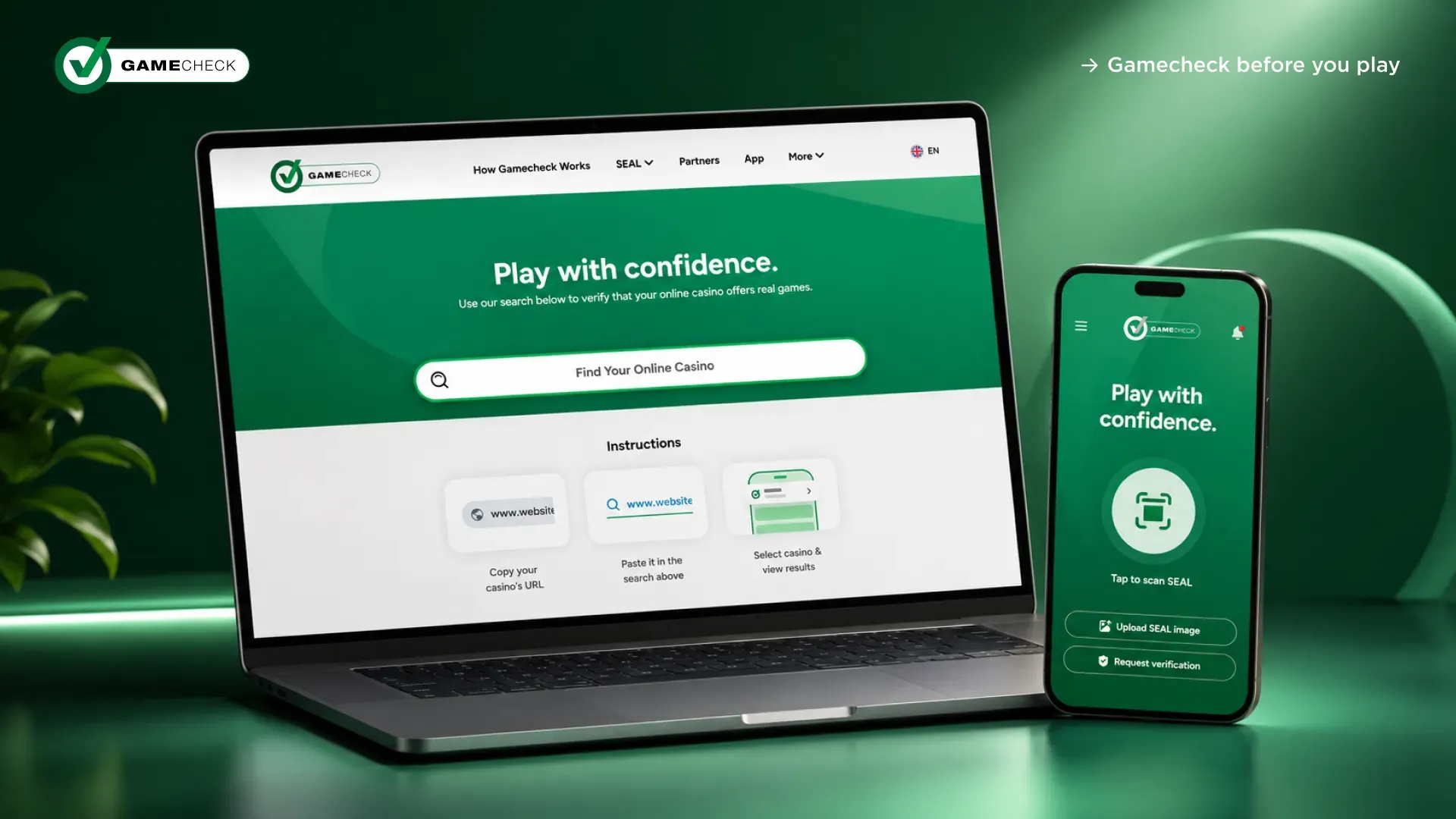
You can use the free Gamecheck Search Tool and Gamecheck Chrome Extension to check any online casino before you deposit. If you've encountered a platform you suspect isn't playing fair, submit a report at Request Casino Verification | Gamecheck. Gamecheck's team will investigate and publish findings to help other players make more informed decisions.
Knowing what to avoid is one side of the picture. The Gamecheck SEAL gives players the other side - a positive, verifiable signal that an online casino's games have been checked and confirmed as real by the original game providers.
The Gamecheck SEAL is displayed in the footer of verified online casinos. It's awarded to platforms whose games have been tested through a randomised selection process. Those checks take place on an ongoing monthly basis, so the Gamecheck SEAL reflects a continuous commitment to game integrity rather than a one-off assessment.
To confirm a Gamecheck SEAL is real, scan the QR code using the free Gamecheck app. The app confirms whether the Gamecheck SEAL is real and linked to the correct domain. If a seal has been copied, the app will flag it simultaneously - meaning the Gamecheck SEAL also functions as an anti-phishing tool, exposing fake operators who attempt to misuse it.
Players can follow up to six online casinos within the Gamecheck app and receive a notification each time a new test result is published. It's a simple way to stay informed about the online casinos you use the most, and to play with confidence.